
World of Statecraft · Elections
Polymorphic Voting
The election is always open. Residents approve candidates in secret, organizations of every kind endorse in public, and a proportional ranked count fills the seats. No organization stands between a resident and the ballot.
Watch the Walkthrough
One Election Cycle, Start to Finish
A film that follows a single race from its first approval to its certified count is in production.
Most Elections Are Decided Before Election Day
The Coalition has long argued for Proportional Ranked Choice Voting, also known as the single transferable vote, because it represents nearly every voter instead of only the largest bloc. The count, however, is the last step of an election. The first step is deciding whose names appear on the ballot, and in most systems that decision belongs to party leadership, to money, or to signature rules that favor organized machines.
Polymorphic voting is the name for how the engine handles the whole cycle. Support takes more than one form: a secret approval, a public endorsement, and a ranked ballot. A candidate is never the property of one organization, and can carry endorsements from many organizations of many kinds at once. The aim is to represent every significant interest at the same time, not to select a winning bloc.
An Election That Never Closes
Anyone May Stand
The only qualification for candidacy is living in the jurisdiction. No fee, no nomination by an organization, no signature drive. A candidate's profile carries their public record automatically.
Approve as Many as You Like
An approval is a simple yes. Residents approve every candidate they find acceptable and withdraw an approval whenever they change their mind. Individual approvals are secret. Only the totals are published, as a daily aggregate.
Approval Sets Ballot Position
At the cutoff, the most approved candidates become the finalists, listed in order of standing. The number of finalists is tied to the number of seats: three per seat by default, so a nine-seat race lists twenty-seven. A legislature may adjust that multiple by law.
The Write-In Always Stands
Missing the cutoff does not end a candidacy. Every qualified candidate stays available on the ranked ballot through a search, so the right to stand, and the right to vote for whom you choose, is never reduced to a short list.
The Open Ballot
The open ballot is a continuous, filterable register of candidates. Each profile shows a statement, the candidate's public record, their endorsements, and their current standing.
A filter lets a voter browse by endorser: any named organization, personal endorsers, or no endorsements at all. Running with no endorsements is a first-class choice.
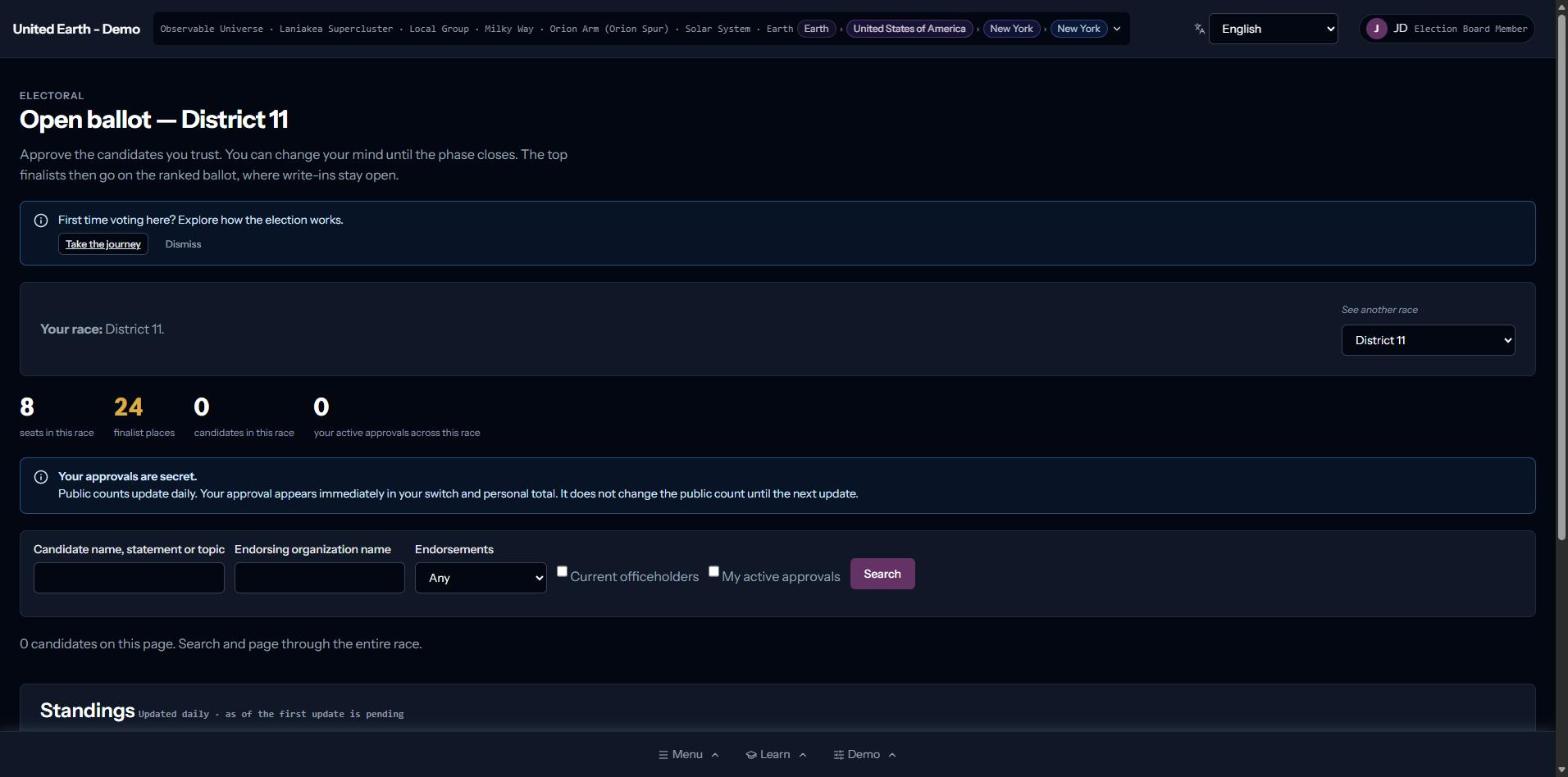
The open ballot for one district at the start of a new cycle, before candidates have registered.
Parties Become Unnecessary, Not Forbidden
The engine has no special category for political parties. A party is an organization, recorded in the same registry as a business, a nonprofit, a common good corporation, or an informal group. The law does not ask what kind of group is speaking. There are individuals, and there are groups of individuals, and that is the whole taxonomy.
Any organization may endorse any candidate, for any reason, and a candidate may hold many endorsements at once: a tenants' association, a trade union, a chamber of commerce, and two parties, all on the same profile. What no organization can do is control the ballot. Because anyone can enter and any voter can approve at any time, the gatekeeping role that made standing parties necessary is simply gone. This obviates parties without banning them. They remain free to organize, persuade, and endorse like everyone else.
Three Ways to Support a Candidate
An endorsement changes what voters know about a candidate. It never changes whether the candidate may run, where they appear, or how a vote is counted. Seats are won by individuals through the ranked count, and proportionality is carried by voters' own preferences, with no group layer anywhere in the tabulation.
Then the Proportional Ranked Count Begins
The ranked ballot uses Proportional Ranked Choice Voting with a fixed quota. Reach the quota and win a seat. Surplus votes transfer to next choices at a reduced value, the last-placed candidate is eliminated, and the process repeats until every seat is filled. The count is instant, and it is published round by round.
Each ballot is secret but checkable. The voter keeps a receipt and can confirm that their ballot was included, using published hashes that reveal nothing about how they voted. A vacancy between elections is filled by recounting the original ballots, so the seat stays with the voters who won it.
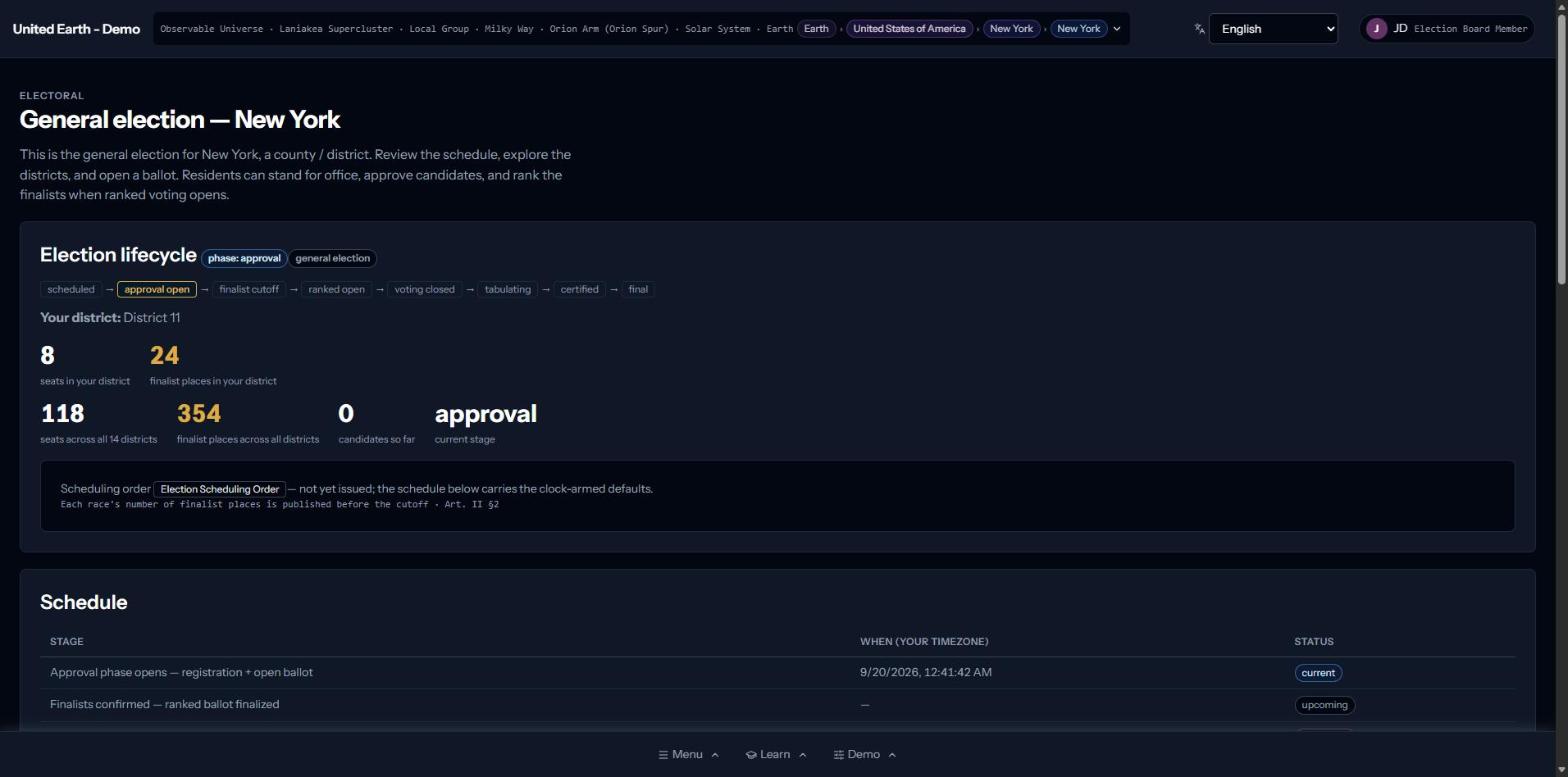
A general election in the live demo: 8 seats and 24 finalist places in this district, 118 seats across the whole race.
Every Stage of an Election on One Screen
Each election page shows the whole life cycle: approval open, finalist cutoff, ranked voting, tabulation, and certification. It shows the seats in your district and the number of finalist places. That number is derived from the seats and published up front, so nobody can adjust it once they can see who is winning.
When the count runs, the result is published round by round. Candidates and the organizations that endorsed them have standing to observe and audit it.
Open the Elections in the Live Demo
The Launchpad
Start here. Election screens open from the game's front door.
The Constitutional Clocks
The election calendar, counting down in public. No official can skip or delay it.
The Counting Code
The protected vote counting service and its constitutional tests.
Related Reading
Proportional Ranked Choice Voting
The count in depth, with an interactive walkthrough.
Legislatures in the Template
The constitutional text on proportional voting and election integrity.
Map Quality Standards
The measurable rules every district map must meet, and the public scorecard each map carries.
The Constitutional Engine
One gate for every civic act, a tamper-evident public record, and rules no administrator can bend.
The Live Civic Room
One meeting surface where the agenda, the vote, the record, and the live conversation share a screen.
Get Involved
Test It Against Your Own Experience
If you run elections, study them, observe them, or organize for them, we want to know where this design would fail in your context.