Open Source · Pre-Alpha · Playable

World of Statecraft

Participatory democracy as running software, from a neighborhood to the planet. A game on the surface. A working constitutional engine underneath.

PLACEHOLDERThis is a placeholder intro video, filmed off the cuff. A better one is coming soon. If you can script, narrate, animate, or edit, help us make it.Help Make Our Videos →

Watch the Intro

A First Look at World of Statecraft

A short introduction to the project. For a deeper look, the guided tour inside the demo walks through the whole system at your own pace.

The Idea

Automate the Administration. Keep the Deliberation Human.

A Fair Constitution describes fair methods for sharing power. This is the software that carries them out.

A constitution is a document, and a document depends on the officials who administer it. Administration is where fairness is most often lost: an election postponed, a count that cannot be checked, a record that goes missing, a boundary drawn to favor whoever holds the pen.

World of Statecraft is the working title of the Cosmopolitan Governance App, an open source implementation of A Fair Constitution, the Cosmopolitan Template. It performs the procedural work directly, so that no administrator is left to capture. People keep the part that only people can do.

The Software Performs

Every Schedule, Count, and Record

Election triggers and term clocks. Tabulation and seat apportionment. District maps from real geography. Conversions between office types. Record keeping and publication. Every threshold and every deadline the constitution sets.

People Do

Everything That Requires Judgment

Debate and persuasion. Hearings and testimony. Negotiation. The vote itself. Nothing else is required of them, and no software decides anything on their behalf.

Who It Is For

Built for Places That Want Participation to Carry Weight

For local governments, civil society, researchers, and any community that wants residents to hold real decisions.

Decision Rights, Not Advisory Roles

Residents elect real seats, file real petitions, and vote in binding referendums. Participation here ends in a decision, entered on a public record.

Standing Infrastructure

Elections, petitions, referendums, committees, juries, and public budgets are permanent procedures, open every day. They do not end when a project or a grant does.

Participation Follows Residence

Living in a place is the only qualification to vote or to stand there. Cities are full of people who live there without formal standing. Here, living there is the standing.

Every Level at Once

Neighborhood, city, region, country, planet. One nested structure gives local voices a structural path to global deliberation instead of a one-off venue.

Your Hardware, Your Data

A council or a community group can host its own instance with one command, on anything from a Raspberry Pi to a cloud server. No licence fee and no vendor.

Alongside the Tools You Already Use

Platforms such as Consul Democracy and Decidim run proposals, budgets, and consultations inside existing institutions. This engine runs the institutions themselves. Layers, not rivals.

Neighborhood
Where you live
Township
Your immediate community
Municipality
Your city or town
County
Your district or county
State or Province
Your region
Country
Your nation
Planet
Everyone
One person, associated at every level at once. The same procedure runs at each level, built from real boundaries and real population data.
Serious Play

A Game on the Surface, Real Procedure Underneath

The same instinct as legislative theatre and live-action role-play: people learn to govern by doing it.
The Front Door

Arrive Through an Invitation, Not a Manual

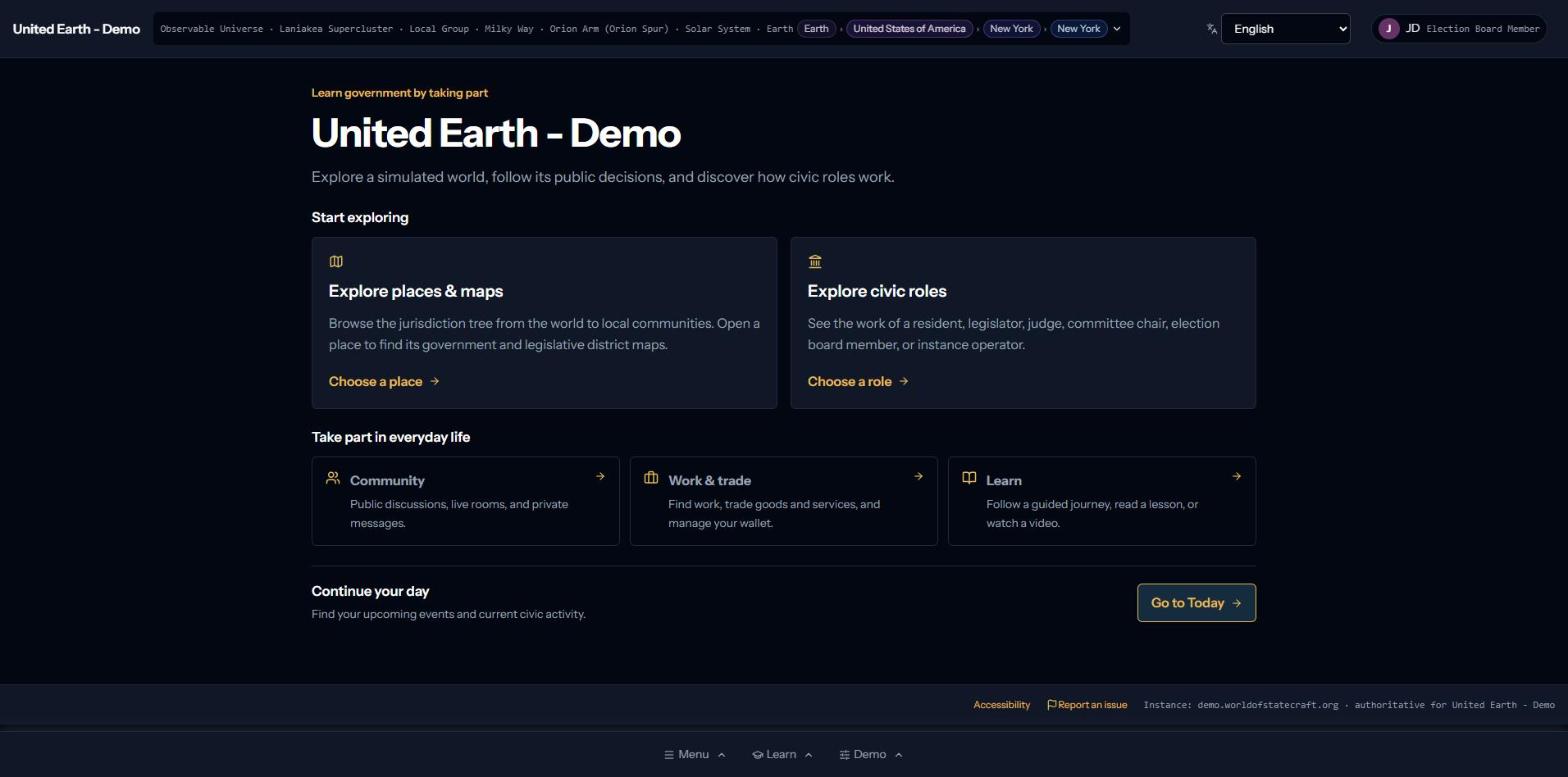
The public face is a game. A launchpad, a guided tour, journeys through real civic processes, and achievements for completing them. It reaches people who would never attend a council meeting.

Underneath, every rule is real constitutional machinery. Play a legislative session, an election, or a court case from start to finish, and every step is the actual procedure.

The launchpad of the live demo.

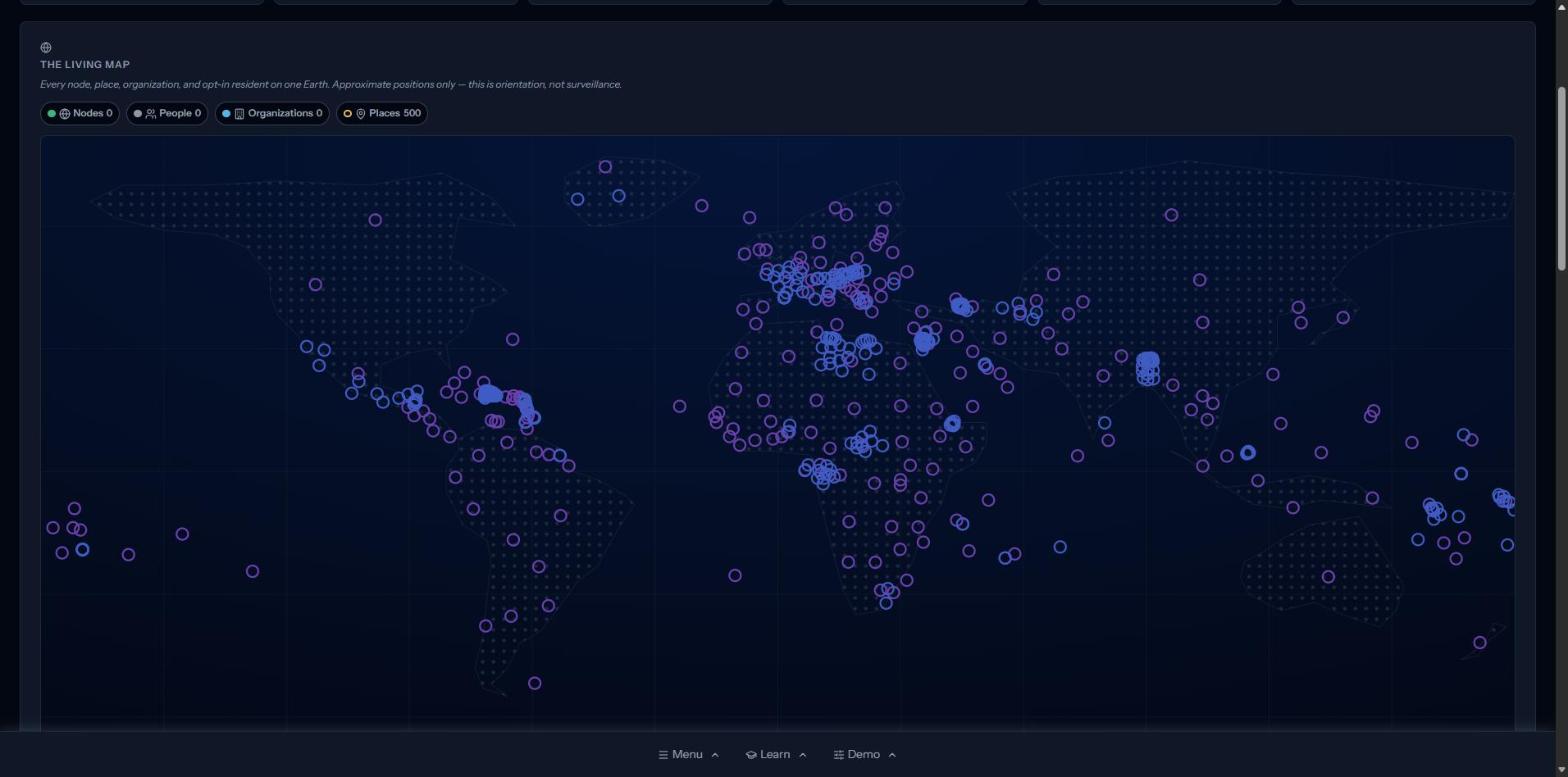
The living map in the Atlas. Positions are approximate by design.

The Whole World

One Public Dashboard for Every Place

The Atlas shows the vital signs of representation, justice, organizations, and the economy for the entire world on one screen.

It is built as a gauge and never a lever. Nothing on it can change a vote, a seat, or a right.

Participation Follows Residence

Living There Is the Standing

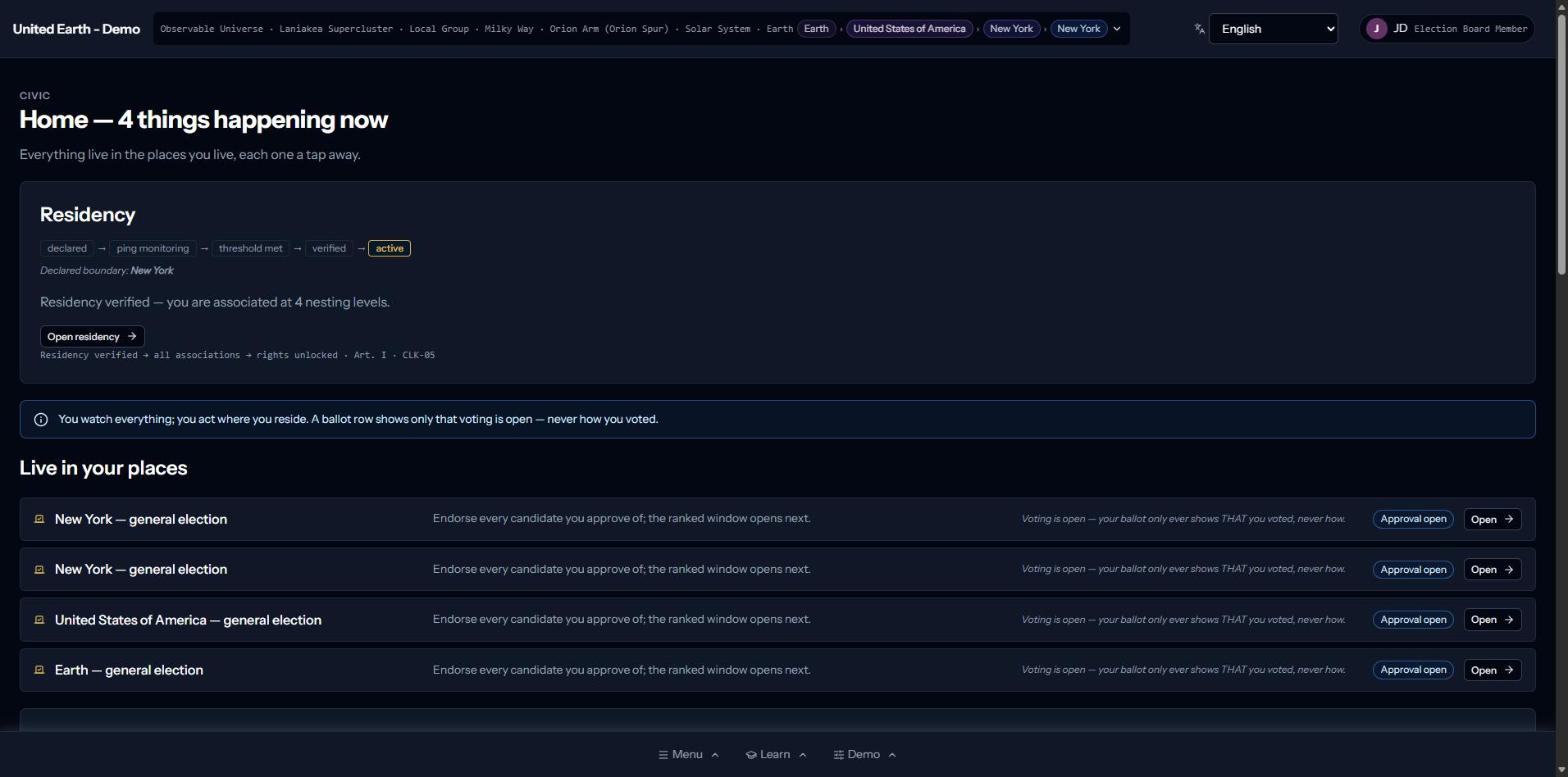
Residency is established from a sustained pattern of presence, and the number of days required is a setting the community itself can change. Once residency verifies, the engine associates the person with every level they live in, and the right to vote and the right to stand unlock automatically. No formal status, no paperwork, no fee.

The civic home then gathers everything live in those places. You can watch everything. You act where you reside.

A resident's home screen: residency verified at four levels, four elections open for approval.

Explore the Engine

Nine Parts, One System

Each page explains one part in plain language and links to the matching screens in the live demo.

Map Quality Standards

The measurable rules every district map must meet, and the public scorecard each map carries.

How the Maps Are Drawn

Open boundary and population data, combined into first-draft districts for the whole planet.

Polymorphic Voting

An election that is always open: approvals, public endorsements, then a proportional ranked count.

The Live Civic Room

One meeting surface where the agenda, the vote, the record, and the live conversation share a screen.

The Atlas

The public dashboard of the whole world. A gauge, never a lever.

Journeys and Learning

Guided journeys, role training, and short films in 77 languages, built into every screen.

Run a Node

Host your own instance on your own hardware, and join a federation with no center.

The Civic Economy

A public ledger, a resident stipend, budgets, and a marketplace under one rulebook.

The Constitutional Engine

One gate for every civic act, a tamper-evident public record, and rules no administrator can bend.

76
Interface Languages
Machine drafts under a constitutional glossary, open to correction by native readers
61
Short Films
Narrated and captioned in 77 languages, one in every screen's Learning Drawer
152 / 152
Screens Pass
The signed-in accessibility roster, checked September 2026
200+
Constitutional Tests
Automated tests that pin the count, the rights, and the proportionality rules
Apache 2.0
Open Source
Anyone can run it, study it, or change it
Where It Stands

This is pre-alpha software. It has not been security-audited and has not been validated in real-world use. It is for evaluation, development, and contribution. It must not be used for real elections, real governance decisions, or real personal data.

The next steps are an independent security audit, native-reader review of the translations, and a public-host rehearsal. Development support and funding would take it from working parts to a fielded system.

See It Running

Open the Live Demo

These screens are public. No account is needed to look around.
The demo is a pre-alpha instance for evaluation. Some areas ask you to sign in, and some open as the demo world finishes building. Nothing entered there is a real civic act.

The Invitation

Help Take It From Working Parts to a Fielded System

Municipalities can host a pilot instance as a laboratory, on their own hardware with their own data. Platform communities can help define how these layers connect. Scholars and rights organizations can review the hardened rules and the privacy model and tell us where we are wrong. Practitioners can bring theatre, role-play, and assemblies into the game. Readers of any language can correct the drafts.