
Reforms · Corporate Governance
Scaling Co-Determination
Balanced Governance for Every Organization
As the number of workers in an organization increases, the power of corporate policy and industry standards starts to affect more individuals. Just as a government is, in some sense, a business, a business is also, in some sense, a government. Scaling Co-determination, in conjunction with Regulatory Parity, balances the interests of material investors and labor investors.
Test Your Knowledge
This page and its video include a quiz you can take to test your understanding of the content. This lesson is part of a larger education series.
The Core Idea
Resources + Work = Products & Services
A business is, in some sense, a government. Scaling co-determination — alongside regulatory parity — balances the interests of the people who fund it and the people who run it.
scaling co-determination balances power between material and labor investors, ensuring fair representation in corporate governance.
Material Investors
Resources are contributed by Material Investors and cannot change states without Workers.
- Cash and Investments
- Real Estate and Facilities
- Machinery and Equipment
- Patents and Trademarks
- Land and Mineral Rights
Labor Investors
Work is contributed by Labor Investors whom cannot do their jobs without Resources.
- Decision Makers and Managers
- Operators and Producers
- Marketers and Sales Reps
- Financial and Legal Counsel
- Administrative Support Staff
Power Shifts as the Organization Grows
When one worker joins, material investors still hold the board. As the workforce scales toward parity, board seats shift with it — until labor and capital are represented in balance.
The Comparison
Which Model Represents Everyone?
Four ways to structure a board. Only some give both material and labor investors a real say — here is how each one splits the power.
Traditional Board
Material Investors do not sell shares nor share decision power with labor investors.
Employee Stock Ownership Program (ESOP)
Material Investors Sell Shares to Labor Investors. Vesting Implementations vary.
Scaling co-Determination
Material Investors share decision power with Labor Investors as the number of Labor Investors increases until parity.
Worker Co-Op
Worker Co-Ops begin as equal partnerships and often have vesting schedules for new hires. Implementations vary.
The Verdict
The Answer: A Three-Way Tie
On representation alone, three of the four tie. So what sets the best one apart?
All Three Represent Both Sides
ESOPs, Scaling Co-Determination and Worker Co-Ops all end up representing labor and capital alike — they simply get there by different routes. On representation alone, it is a three-way tie.
Employee Stock Ownership Program (ESOP)
As Original Material Investors Divest into the Labor Investors Funds, the Labor Investors become Material Investors as well.
Scaling co-Determination
Material Investors maintain their own material control and it’s benefits. Labor investors and Material investors share policy control.
Worker Co-Op
begin as equal partnerships and so the Labor Investors are always Material Investors as well.
The Tiebreaker
It Fits Every Kind of Organization
Scaling Co-Determination can apply to every type of Organization Ownership or Member Structure. Unlike ESOPs or Co-Ops, it needs no sale of shares — so it works for stock companies, membership organizations, common-good corporations and partnerships alike.
The Board & the Chair
How the Board Is Chosen
Now that the answer is clear, here is how a co-determined board is actually chosen — and how it rebalances as the workforce grows.
A co-determined board is elected by everyone who invests in the enterprise — the shareholders or members who put in capital, and the workers who put in labor. Each side elects its own representatives, and together they elect the Chair.
Electing the Board & the Chair
THE CHAIR JOINTLY
The Chair is the pivot — dually elected by both sides, neutral by design, and empowered to cast the deciding vote only when the board deadlocks.
Scale the Workforce — Watch the Board Rebalance
Drag the slider to grow the workforce. The 12 elected seats shift from material investors toward parity with labor, while the neutral Chair — the 13th seat — never moves.
The Board of Governors
A group elected by both shareholders or members and workers to run the company. Its makeup mirrors who has actually invested in the enterprise.
The Chair of the Board
Dually elected by both sides at once, the Chair stays neutral and casts a vote only to break a tie — so neither capital nor labor can seize permanent control.
Balanced as It Scales
As the workforce grows, worker representatives grow toward parity with share representatives. The neutral Chair holds the balance at every size.
Why It Wins
Why Scaling Co-Determination
It represents everyone who builds the enterprise, costs little to adopt, and adapts to any organization — a blend of all interests and expertise.
What Makes It Work
One reform that guarantees a voice to everyone who builds the enterprise — the people who put in capital and the people who put in the work.
Represents Material Investors
Guarantees representation and freedom for material investors (shareholders, members, partners, the common good) in their economic life.
Represents Labor Investors
Guarantees representation and freedom for labor investors (workers, employees, independent contractors) in their economic life.
Inexpensive to Implement
Brings Labor Expertise to the board without affecting material investments as they require no material divestment to implement.
Highly Adaptable
Works for non-stock organizations such as Common Good Corporations and Membership Organizations.
A Mixture of Experts
When Combined with Proportional Ranked Choice Voting Co-Determined Boards are a blend of ALL Material Investor and Labor Investor interests and expertise.
Worker Seats That Scale, in Software
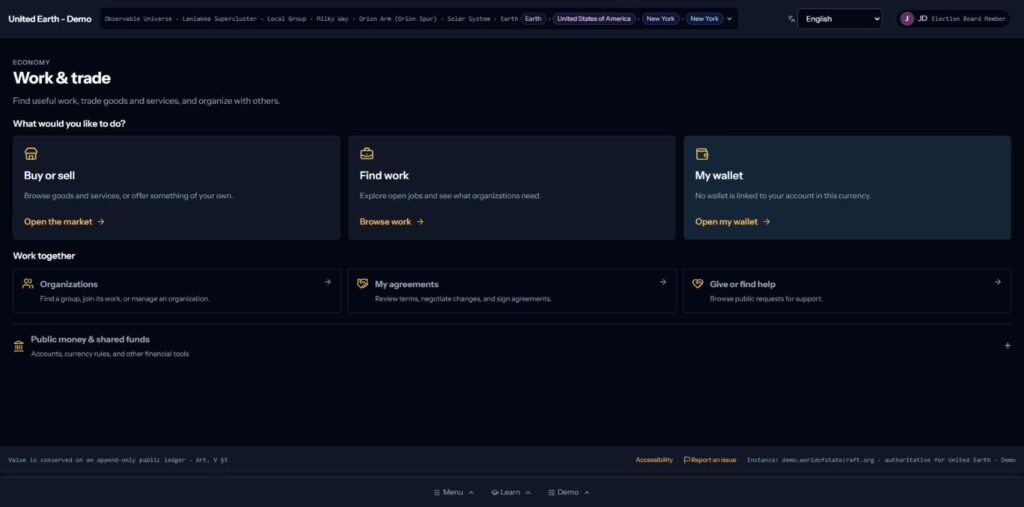
World of Statecraft applies the thresholds described here automatically: the first worker seat at 100 employees, and parity with owners at 2,000. The code is open source.
Get Involved
Help Us Complete This Vision!
A business is, in some sense, a government — and everyone who invests in it deserves a voice. Bring your creativity, skills, or resources to the Cosmopolitan Coalition and help make balanced governance the norm.