World of Statecraft · Civic Education

Journeys and Learning

People learn to govern by doing it. Guided journeys, role training, and short films in 77 languages are built into every screen, so that nobody needs a manual to take part.

COMING SOONThis walkthrough is being recorded. If you can script, narrate, animate, or edit, help us produce it.Help Make Our Videos →

Watch the Walkthrough

Your First Journey

A film of a newcomer arriving by invitation and completing a first journey is in production.

The Principle

Serious Play: Every Player Is a Rule-Maker

The game reaches people who would never attend a council meeting, and what they practice is the real procedure.

Civic education usually explains institutions from the outside. A diagram of how a bill becomes law teaches far less than carrying a bill through a committee, losing a vote, amending the text, and trying again. Practitioners of legislative theatre and live-action role-play already know this: people understand power when they hold some of it, even in rehearsal.

The engine applies that instinct to a complete system of government. A journey walks a newcomer through a real process one step at a time, with a clear statement of where they are, what their part is, and what happens next. The steps are not a simulation of the procedure. They are the procedure.

Becoming a ResidentAn Election, End to EndA Committee Session, LiveA Bill Becomes LawA Court Case, End to EndEnacting a BudgetStarting an OrganizationHolding a Board MeetingAn Informal Group Forms and MeetsAsking For and Giving HelpFrom a Petition to a ReferendumA Government Creates a Public ServiceThe Money Between a Person and Their GovernmentTwo Governments Meet, Trade, and Merge
Fourteen journeys, each a guided path through a real civic process.

Arrive by Invitation

A newcomer can land from a shared link, pick a name, and step straight into a room. Invitations carry no power. They only open a door.

Explore a Role Before You Hold It

The role explorer shows what each civic role may do and how a person comes to hold it, from resident to speaker to judge.

Achievements That Confer Nothing

Completing a journey earns a permanent achievement on a sealed record. Achievements are private by default, and they are walled off from votes, seats, and money. Recognition never becomes a governance advantage.

Made for Classrooms and Youth Councils

A class or a youth council can hold a genuine proportional election, seat a genuine council, and run sessions under real rules of order, with nothing at stake except what they learn.

In the Engine

A Learning Drawer on Every Screen

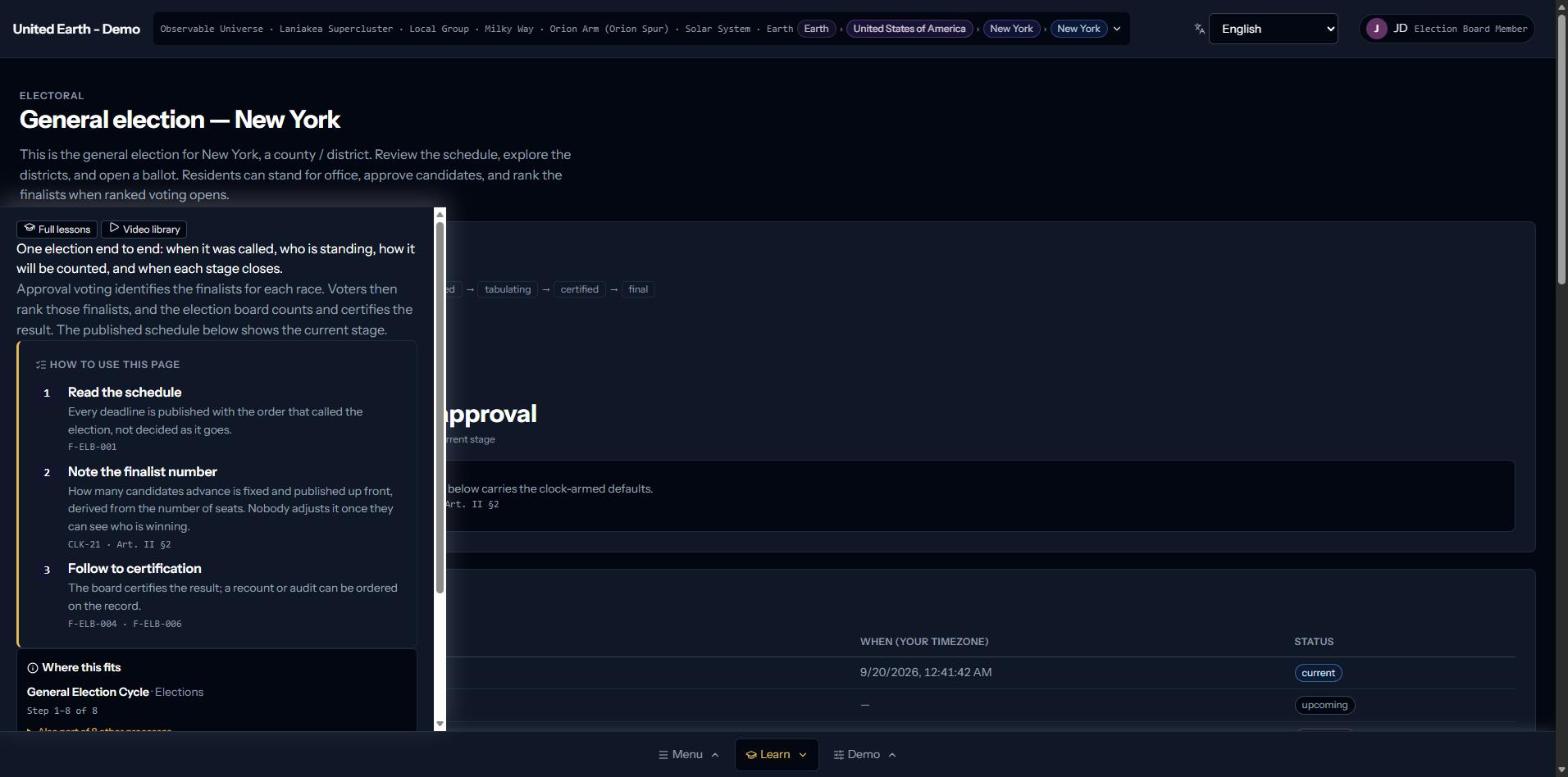
Every screen has a drawer that explains what the screen is for, where it fits in the larger process, and which part of the constitution it carries out. Most drawers open a short film.

The teaching sits beside the task, at the moment a person needs it.

The Learning Drawer beside an election page: what the page is for, how to use it, and where it fits in the cycle.

Role Training

Training Before Office

Some powers should only be used by people who understand them.

Six training tracks prepare people for the offices that carry the most responsibility. Each track is a series of lessons with a graded knowledge check, and the pass mark is 80 percent. Seventy-four of the engine's official filings are gated behind the matching training, so an office holder cannot use a power they have not been trained to use. Training is open to everyone, and anyone may prepare for an office before they stand for it.

1Legislature
For members of a chamber: sessions, motions, committees, and the path of a bill.
2Election Board
For the independent officials who run elections and adopt district maps.
3Executive
For those delegated or elected to carry out the law.
4Board of Governors
For the neutral, appointed boards that run public departments.
5Judiciary
For judges: cases, panels, and constitutional review.
6Advocate
For those who represent others before a court.
Everyone, Everywhere

In Their Own Language

61 Films in 77 Languages

The Coalition's lesson films play inside the engine from one silent master with separate narration and captions for each language. A viewer can mix them, for example narration in one language with captions in another.

76 Interface Languages

Every string of the interface exists in 76 languages. English is the source. Every other language is a machine draft made under a constitutional glossary, checked automatically, and graded by sample. No human has yet read most of them end to end, and the engine says so.

Native Readers Correct the Drafts

Anyone who reads a language can add it to their record and open the translation board, which queues the drafts for that language. Every confirmation and correction is recorded.

Accessible by Requirement

All 152 signed-in screens passed the automated accessibility roster in September 2026, and the engine publishes its accessibility statement openly. Testing with people who use assistive technology remains a next step.

14
Journeys
Guided paths through real civic processes
6
Training Tracks
For the offices with the most responsibility
80%
Pass Mark
On every graded knowledge check
61
Films
Narrated and captioned in 77 languages
76
Languages
In the interface, open to correction
See It Running

Open Learning in the Live Demo

The demo is a pre-alpha instance for evaluation. Some areas ask you to sign in, and some open as the demo world finishes building. Nothing entered there is a real civic act.
Keep Exploring

Related Reading

The Live Civic Room

One meeting surface where the agenda, the vote, the record, and the live conversation share a screen.

Polymorphic Voting

An election that is always open: approvals, public endorsements, then a proportional ranked count.

World of Statecraft

The whole engine at a glance: what it is, who it is for, and where it stands.

Education and Training

The Coalition's courses and lesson series.

Translation Status

The Coalition's translation programme across 77 languages.

The Course Catalog

Structured courses on the Template and its principles.

Get Involved

Read a Language? Teach a Class? Run a Youth Council?

Native readers can fix a translation in minutes. Teachers and youth workers can run a first session with us and tell us what confused their group. Both make the engine better for the next person.