World of Statecraft · Public Finance

The Civic Economy

A public ledger that anyone can audit, a stipend tied only to residency, budgets enacted in the open, and a marketplace under one rulebook. Built into the same engine as the elections.

COMING SOONThis walkthrough is being recorded. If you can script, narrate, animate, or edit, help us produce it.Help Make Our Videos →

Watch the Walkthrough

The Money Between a Person and Their Government

A film following one budget from enactment to the public ledger is in production.

The Principle

Economic Self-Determination Under One Rule

A Fair Constitution imposes no economic model. Each jurisdiction decides for itself what public enterprise, if any, it undertakes.

The single binding rule is regulatory parity: public and private providers of the same good are regulated identically. A city may run its own water utility, license a cooperative, or leave the field to private firms. Whatever it chooses, the rules for water are the rules for water.

The engine carries that principle into software. It does not choose a model. It records who owns what, applies the same rulebook to each, and publishes the accounts.

Public Service
Owned by a legislature
A department or a Common Good Corporation, created by law to provide a good
Public and Private Partnership
Owned by its members
Cooperatives, mutuals, and member-owned bodies
Private Enterprise
Owned by shareholders
Businesses of every size
One rulebook across the whole spectrum. The same good carries the same regulation, wherever the provider sits.
What Is Built

Public Money on a Public Record

Public finance and the market are part of the running engine, exercised so far at demonstration scale.

A Double-Entry Public Ledger

Every movement of public money is a balanced entry on a ledger whose entries are chained together, so that an altered entry breaks the chain and shows. One service is the only writer. Anyone can read the books.

Budgets Enacted in the Open

A budget is passed like any other law, through committee and floor votes on the public record. Spending follows appropriations, and appropriations follow acts. Revenue, borrowing, and the treasury are visible pages.

A Stipend Tied Only to Residency

Where a jurisdiction funds a resident stipend, eligibility is an active residency and nothing else. The totals are public and each person's receipt is private. Switching the stipend off changes nobody's rights.

A Wallet Is Private, Like a Ballot

Public accounts are public. Personal wallets are readable only by their owner. No dashboard, including the Atlas, ever shows an individual balance.

A Marketplace and a Labor Board

Residents and organizations can list goods and services, post work, and apply for it. Hires feed directly into the worker representation rules, so a growing employer gains worker seats on schedule.

Mutual Aid

A resident can ask for help, and neighbors can give it, inside the same system.

In the Engine

The Economy, Open to Read

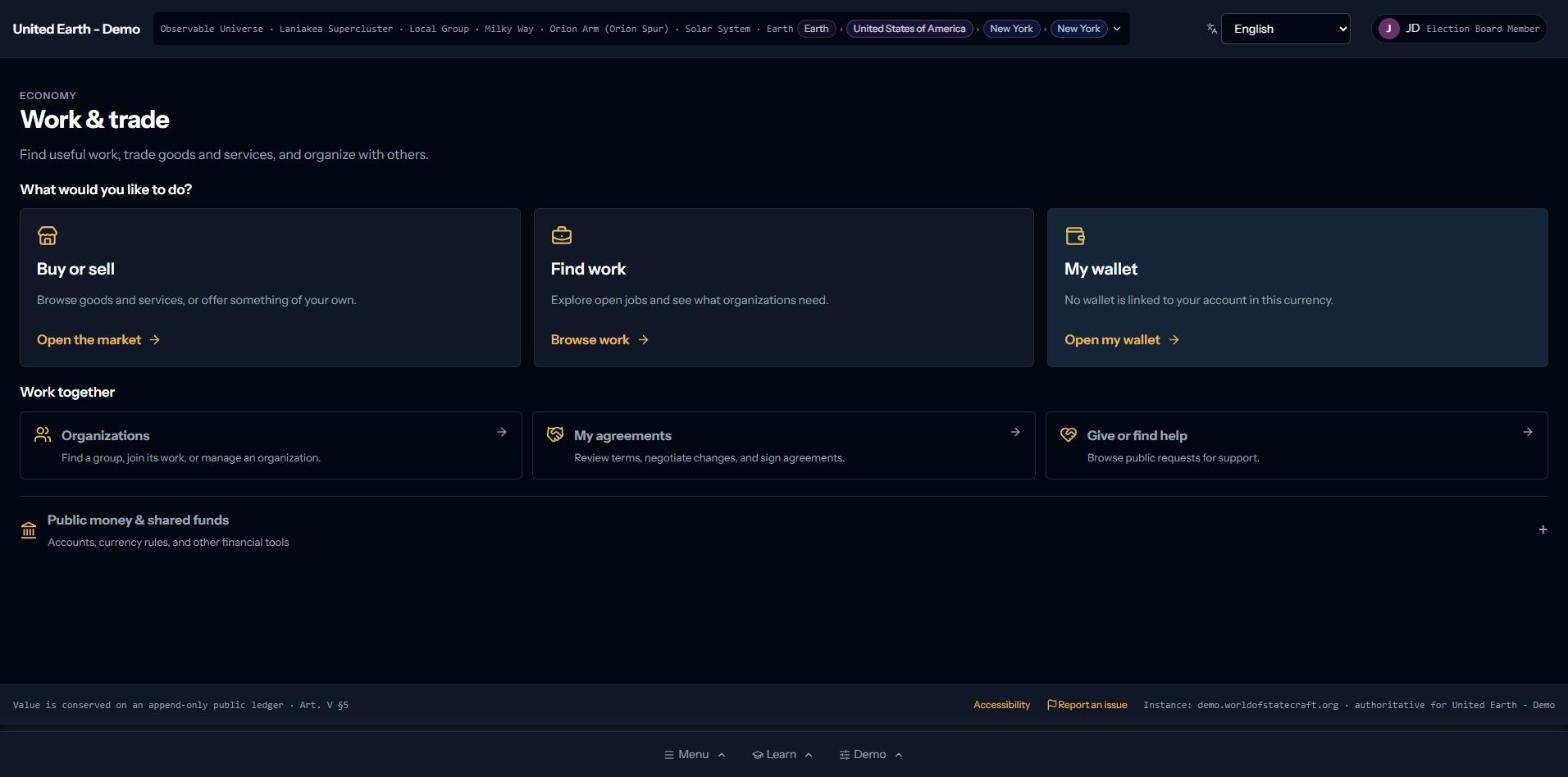
The economy pages are public reading: the market, the treasury, the units of account, the stipend, agreements, and joint ledgers that two or more parties control together.

In the demo, the economy runs on its own internal units. No real money is involved anywhere.

Work and trade in the live demo. Value is conserved on an append-only public ledger.

Inside Organizations

Representation Does Not Stop at the Office Door

The same proportional principle that fills a legislature also reaches inside the organizations where people spend their working lives.

Worker Seats That Scale

As a workforce grows, workers gain seats on the board. The first worker seat arrives at 100 employees, and representation rises to parity with owners at 2,000. Worker seats are filled by election. Read about scaling co-determination.

Any Entity Can Register

Private firms, worker-owned and member-owned bodies, nonprofits, informal groups, and public Common Good Corporations all sit in one registry under the same rules.

Public Work Stays Public

The intellectual property of a Common Good Corporation is public domain by constitutional rule. What the public pays to create, the public keeps.

Ownership Can Convert

An enterprise can move between private, member, and public ownership through defined processes, and shares can be issued and traded between holders.

No Paywall on a Civic Right

Taxes and fees exist in the engine. None of them can ever be a condition of voting, standing for office, petitioning, or serving on a jury. The constitution forbids charging for a civic right, and the engine pins that rule with an automated test. The economy is a service to the polity. It is never a gate in front of it.

Where It Stands

The financial engine is built and its accounts balance under test. It has been exercised in small demonstration worlds, not at the scale of a real city, and its interfaces are younger than the election and legislature screens. Treat everything here as a working model to evaluate, not as a system to move real money through.

See It Running

Open the Economy in the Live Demo

The demo is a pre-alpha instance for evaluation. Some areas ask you to sign in, and some open as the demo world finishes building. Nothing entered there is a real civic act.
Keep Exploring

Related Reading

The Constitutional Engine

One gate for every civic act, a tamper-evident public record, and rules no administrator can bend.

Polymorphic Voting

An election that is always open: approvals, public endorsements, then a proportional ranked count.

The Atlas

The public dashboard of the whole world. A gauge, never a lever.

Regulatory Parity

One rulebook for public and private providers of the same good.

Scaling Co-Determination

How worker representation grows with the workforce.

Governments in the Template

Departments, public enterprise, and the executive.

Get Involved

Help Us Model Public Money Honestly

If you work in municipal finance, participatory budgeting, cooperatives, or labor representation, tell us where this model would break against real practice.