
World of Statecraft · Trust
The Constitutional Engine
One gate for every civic act. A public record that shows its own tampering. Rules that no administrator, and no compromised account, can bend. This is why the results can be believed.
Watch the Walkthrough
One Filing, From Click to Public Record
A film that follows a single act through the engine, including one that is refused, is in production.
A Constitution That Executes
Every constitution makes promises. The distance between a constitutional promise and daily practice is where rights are lost: an election postponed for good reasons, a threshold reinterpreted, a record amended after the fact. Each step is small, and each is taken by someone with the authority to take it.
The engine removes that discretion from the procedural layer. Every state-changing civic act, whether it arrives from a browser, a background job, or the scheduler, passes through a single entry point. There is no second door, and no administrative panel that can edit the result.
Refusals Are Records Too
When an act violates the constitution, the change is rolled back and the refusal itself is written to the public chain, with the constitutional citation that caused it. An attempt to break the rules leaves evidence.
No Model Decides Anything
The engine is deterministic. The same filing always produces the same result. Where artificial intelligence appears at all, in translation drafts and as an advisory aid, it assists a human and holds no authority.
More Than 130 Kinds of Official Act
Every power in the constitution is expressed as a named filing: declaring residency, registering a candidacy, introducing a bill, calling a vote, adopting a district map, challenging a law. Nothing official happens any other way.
Roles Are Derived, Never Granted
Nobody is made a resident, a candidate, or a member by an administrator. A role exists because the record shows the facts that create it, and it ends when those facts end.
Two Layers: What Can Change, and What Cannot
Nothing here freezes a society in place. A legislature can change its own settings within lawful bounds, and the constitution can be amended through its own ratification process. What cannot happen is a quiet change: a threshold lowered by an official, a rule skipped once for convenience, or a compromised account rewriting the fundamentals.
Tamper-Evident, Public, and Verifiable by Anyone
A Chain of Hashes
Every entry in the audit record commits to the entry before it, back to a fixed first entry. Altering any past entry breaks every link after it. The chain can be verified at any time.
The Clocks Are a Public Page
Every deadline the constitution sets is counting down in public: the next election, the end of each term, the expiry of any emergency power. Officials deliberate. The system keeps the calendar, and no official can skip or delay it.
Any Inhabitant Can Challenge a Law
A resident can bring a constitutional challenge. The legislature may amend or override within a fixed window. If it does neither, the court may correct the text of the law directly, and every earlier version stays on the record.
Privacy by Design
Location check-ins exist only to establish residency and never enter the audit chain. A ballot has no link to a voter anywhere in the database. Each voter holds a receipt and can confirm their ballot was counted without revealing it.
Every Deadline, Counting Down in Public
The clocks page lists every timer the constitution sets. The demo shows 22 clocks in the registry: 15 that a legislature may amend through settings, and 7 that are hardened or structural. Elections fire on schedule. Emergency powers lapse within ninety days. Terms for the legislature, the executive, and the courts move together from a single clock.
The page needs no account. The calendar of a government is a public record.
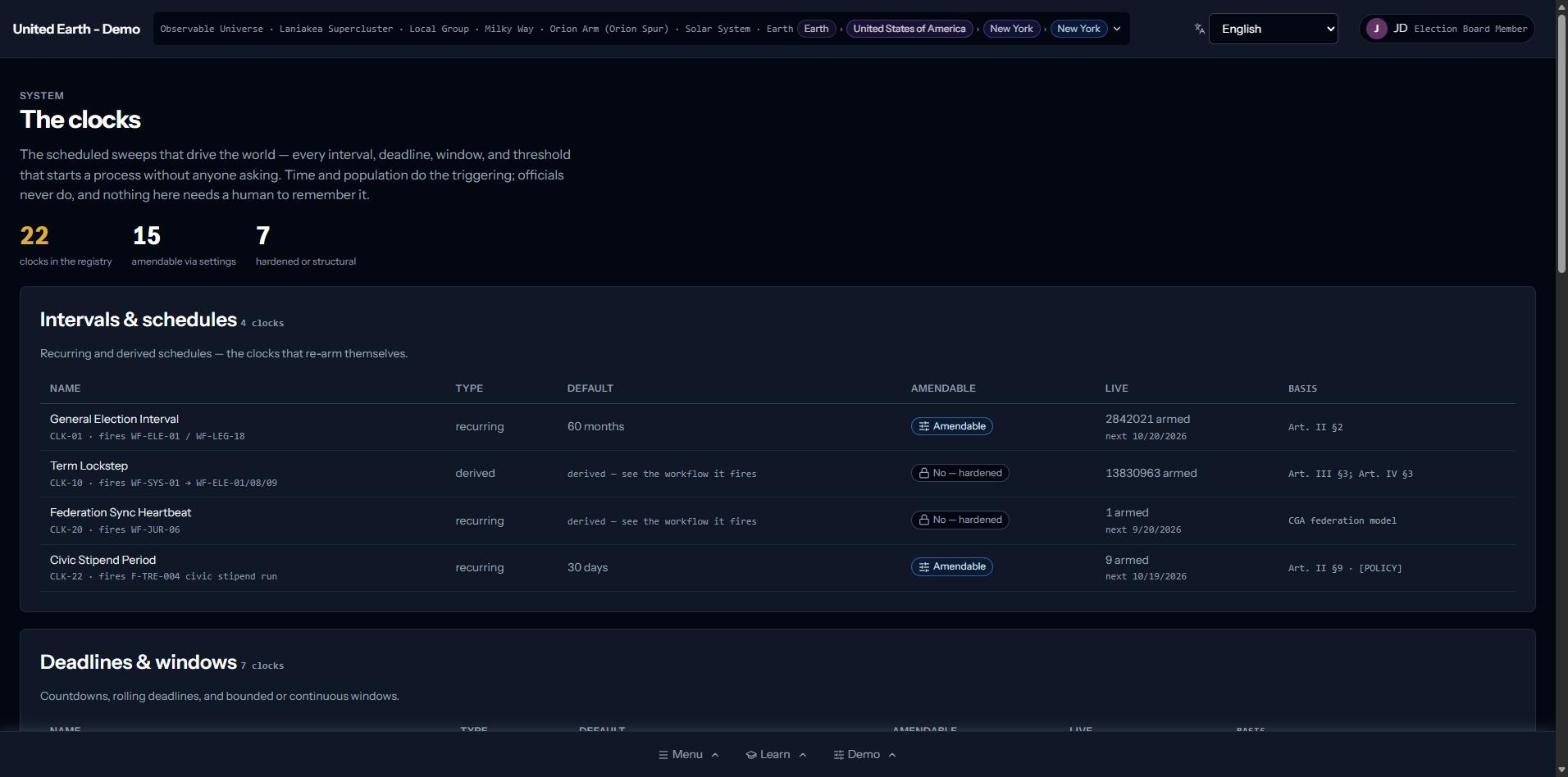
The clocks in the live demo: the general election interval is amendable, the term lockstep is hardened.
Claims and the Evidence for Them
The software is pre-alpha. It has not had an independent security audit, and it has not been validated in real-world use. Tests prove that the rules hold in the cases someone thought to test. They do not prove the absence of flaws. Reviewing the hardened rules and the privacy model is exactly the help the project needs from constitutional scholars, security researchers, and rights organizations.
Open the Engine in the Live Demo
The Accessibility Statement
The commitments and how they are checked.
The Constitutional Tests
More than two hundred test files that pin the hardened rules.
Related Reading
Polymorphic Voting
An election that is always open: approvals, public endorsements, then a proportional ranked count.
Run a Node
Host your own instance on your own hardware, and join a federation with no center.
Get Involved
Tell Us Where We Are Wrong
Constitutional scholars, privacy and security researchers, and human rights organizations: the rules and the tests are public. Your critique is the most useful contribution this project can receive.