
The Cosmopolitan Template · Article V
Jurisdictions and Their Powers
Learn about jurisdictions and their powers, including governance, resource management, and maintaining legal order and individual rights.
Watch & Learn
Test Your Knowledge
This Webpage and Video Have a Quiz you can take to test your knowledge and understanding of the content. This lesson is part of a larger education series.
The Shape of Governance
Containers Within Containers
A jurisdiction is a self-governing container — of individuals, and of other jurisdictions. Every layer holds many co-equal members: Earth holds some 195 sovereign states, and the United States is just one of them. Follow the gold path down one branch — from the whole Earth to a single county.
The terms are relative — each gold jurisdiction is a constituent of the band above it and the encompassing jurisdiction of the band below. And the nesting branches: India, California, or Brooklyn each contain the same kind of layers. The sections below define their duties and powers in the constitution’s own words.
Execution of Constituent Will and Preservation of Rights
“Jurisdictions faithfully carryout the will of their constituents while also preserving the rights of all Individuals, respecting the boundaries of all Jurisdictions, and upholding Constitutional Order everywhere. Powers granted to Jurisdictions are granted to them by their population.”
A jurisdiction’s power is granted by its own population — and only by them. In exchange it must faithfully carry out its constituents’ will, preserve everyone’s rights, respect its neighbors’ boundaries, and uphold constitutional order everywhere.
Co-Equal Self-Governance
“Jurisdictions are co-equal self-governing containers of Individuals and other Jurisdictions.”
Every jurisdiction — from a county to the whole Earth — is a self-governing container of individuals and of other jurisdictions. None is another’s subject; they meet as equals.
Management of the Common Good
“Jurisdictions manage the Common Good in their boundaries.”
Within its own boundaries, each jurisdiction stewards the common good — the shared goods, services, and spaces its people rely on.
Promotion of Peace and Prosperity
“Jurisdictions maintain relationships with other Jurisdictions to promote peace and prosperity for their respective constituents.”
Jurisdictions keep working relationships with one another so their peoples can trade, cooperate, and live in peace.
Uniform Application of Law
“Jurisdictions apply the law consistently and uniformly across all Constituent Jurisdictions.”
A jurisdiction’s law means the same thing everywhere inside it — applied consistently and uniformly across all of its constituent jurisdictions.
Control and Sharing of Resources
“Jurisdictions control natural resources and other assets within their boundaries while jointly sharing resources that flow through or exist indivisibly between multiple Jurisdictions.”
What lies within one jurisdiction’s boundaries is its to manage; what flows through or spans several — rivers, air, migrating resources — is shared jointly.
Resolution of Disagreements
“Jurisdictions resolve disagreements between each other or their constituents using Legislative and Judicial processes.”
When jurisdictions or their constituents disagree, the dispute goes to legislatures and courts — never to force.
Ensuring Compatibility and Interoperability
“Jurisdictions ensure full compatibility and interoperability between each other and their constituents.”
Systems, standards, and institutions are kept compatible across boundaries, so life and commerce work seamlessly between jurisdictions.
Full Faith and Credit
“Jurisdictions give Full Faith and Credit to every associated Jurisdiction’s public Acts, Records, and Judicial proceedings.”
Each jurisdiction honors the others’ public acts, records, and court proceedings — a judgment or record in one is respected in all.
Maintenance of Defensive Forces
“Jurisdictions maintain defensive forces that preserve their boundaries, keep the peace, and uphold constitutional order.”
Jurisdictions keep forces that are defensive by design: they preserve boundaries, keep the peace, and uphold constitutional order.
Respect for Jurisdictional Boundaries
“Jurisdictions respect the boundaries of all other Jurisdictions and do not unilaterally change their boundaries. Two or more Jurisdictions may agree to new shared boundaries. If a Supermajority of the Population in the affected area agree then the new boundaries are adopted.”
No jurisdiction may redraw a boundary on its own. Borders change only by mutual agreement — and only if a supermajority of the people actually living in the affected area consent.
Representation in Bicameral Legislatures
“Individuals are represented in a bicameral Legislature when a Jurisdiction contains Constituent Jurisdictions.”
When a jurisdiction contains constituent jurisdictions, its legislature seats two kinds of representatives — so both the people and the member jurisdictions have a voice.
Apportionment of Representative Seats
“A number of Representative Seats are apportioned out to the Constituent Jurisdictions by their relative populations and a number are apportioned out to the Jurisdictions equally.”
Some seats are distributed by relative population (bigger constituencies, more seats); the rest are distributed equally, one share per constituent jurisdiction, however small.
Election of Representatives
“The Representatives in Seats being apportioned out equally are elected by the whole population in the same way and at the same as the Representatives in Seats apportioned out by relative population.”
The equally-apportioned seats are not appointed by member governments — they are elected by the whole population, by the same method and on the same schedule as the population seats.
Committee Composition
“Members of both kinds sit on the same Committees. The proportion of each kind of seat on a committee is the same as the relative proportion of each kind of seat in the whole Legislature.”
Committees mirror the whole: both kinds of members sit together on every committee, in the same proportion as in the full legislature.
Independent Agreement for Legislative Actions
“Members of both kinds must agree independently for any act, appointment, proclamation, or other decision to pass Committee or enter general law. In all other ways, members work, debate, and vote together as one Legislature.”
For anything to pass — an act, appointment, or proclamation — the population seats and the equal seats must each agree independently. In every other way they debate and work as one body.
Minimum and Maximum Number of Representative Seats
“Unless otherwise amended, The Minimum number of Representative Seats in a Jurisdiction, or in any necessary subdivision is five (5) with the maximum being nine (9).”
The defaults are concrete: every body or necessary subdivision seats at least five and at most nine representatives.
Two Kinds of Seats
One Legislature, Two Independent Majorities
Where a jurisdiction contains constituent jurisdictions, its legislature seats representatives of two kinds — some apportioned by population, some equally per jurisdiction. They work as one body, but every act needs both groups to agree independently.
Establishment of Uniform Structures and Procedures
“All Jurisdictions jointly and co-equally have the power to establish uniform structures and standard operating procedures for the administration of Executive Departments and Corporations of Common Good. Constituent Jurisdictions maintain control over the appointment of their local boards and other local personnel.”
Jurisdictions jointly standardize how executive departments and common-good corporations are structured and run — while each constituent keeps control of appointing its own local boards and personnel.
Imposition and Collection of Taxes and Fees
“Jurisdictions impose and collect taxes, fees, and charges to settle debts and ensure the overall safety and well-being of their Jurisdictions Population.”
Jurisdictions can raise the revenue they need — taxes, fees, and charges — to settle their debts and secure their population’s safety and well-being.
Borrowing Funds
“Jurisdictions borrow funds based on their credit.”
They can also borrow, on the strength of their own credit.
Mobilization of Defense Forces
“Jurisdictions mobilize defense forces to uphold Constitutional Order, quell uprisings, and ward off attacks.”
When constitutional order is threatened — uprising or attack — jurisdictions can mobilize their defensive forces to meet it.
Acquisition of Land and Capital for Infrastructure
“Jurisdictions purchase the necessary lands and capital at a fair market value for the creation of any infrastructure that is necessary for the orderly operation of the Jurisdiction.”
Needed infrastructure can’t be held hostage: jurisdictions may buy the necessary land and capital — at fair market value — to build it.
Establishment of Official Language(s) and Protection of All
“Jurisdictions establish at least one official language for the purpose of standardizing official communication but cannot disallow the enactment of any other official language by any constituent Jurisdiction, nor deny the right of any Individual to speak or write in any language.”
A jurisdiction names at least one official language so official business is standardized — but it can never block a constituent from adding its own official language, nor deny any person the right to speak or write in any language.
Enactment of Laws
“Jurisdictions enact laws to carry out their constitutional duties.”
Jurisdictions pass the laws needed to carry out their constitutional duties.
Provision of Punishments for Crimes
“Jurisdictions provide punishments for crimes against Individuals and their property.”
They define and provide the punishments for crimes against people and their property.
Promotion of Progress in Science and the Arts
“Jurisdictions promote progress in science and the arts by offering creators and innovators exclusive rights to their works for designated durations.”
To spur invention and creativity, jurisdictions can grant creators exclusive rights to their works — for limited, designated durations, not forever.
Resolution of Legal Questions
“Jurisdictions resolve any questions of law that arise from the reading and interpretation of their Constitutions.”
Questions about what their own constitutions mean are resolved by the jurisdictions themselves, through their own institutions.
Currency Production and Regulation
“The most encompassing Jurisdiction of A Fair Constitution reserves the power to produce and regulate currency, determine its worth, and define standards for measurements necessary for regulating industry and commerce.”
Money is reserved to the top: only the most encompassing jurisdiction issues and regulates currency, sets its worth, and defines the standard measures commerce depends on.
Oversight of Extra-Jurisdictional Trade and Relationships
“Encompassing Jurisdictions can oversee extra-jurisdictional trade and relationships.”
Trade and relationships that cross beyond a jurisdiction’s members are overseen at the encompassing level.
Management of Mass-Destruction Weaponry
“Encompassing Jurisdictions can authorize and oversee the possession and management of mass-destruction weaponry.”
Weapons of mass destruction are never a local matter: only encompassing jurisdictions may authorize and oversee their possession and management.
Coordination of Military Units
“Encompassing Jurisdictions can create standardized protocols for the coordination of military units.”
Encompassing jurisdictions set the standard protocols that let military units coordinate across their members.
Allocation of Military Resources
“Encompassing Jurisdictions can institute and allocate resources for military forces for a period not to exceed a regular Legislative term.”
Military forces are funded on a short leash: resources are allocated for no longer than one legislative term at a time, so each new legislature must consciously renew them.
Declaration of War
“Encompassing Jurisdictions can, by Super Majority vote of their Legislature, declare war.”
War is never one leader’s decision — only a supermajority of the encompassing legislature can declare it.
Setting Age of Consent and Majority
“Encompassing Jurisdictions can set a fixed and uniform universal age of consent and majority for all purposes except for voting or standing for office which cannot be denied to any age.” “Unless otherwise amended, The Age of Consent and Majority is eighteen (18) years.”
One uniform age of consent and majority (18 by default) applies for every purpose except one: voting and standing for office can never be denied to any age.
Supremacy of Encompassing Constitutions
“The Constitution of Encompassing Jurisdictions take priority over the Constitutions of Constituent Jurisdictions when there is a conflict.”
When constitutions collide, the encompassing jurisdiction’s constitution takes priority over its constituents’.
Recognition of Cultural Institutions of State
“Jurisdictions may, by Supermajority vote, recognize Cultural Institutions of State to represent the Essence of a Jurisdiction.”
A jurisdiction may — by supermajority — recognize a cultural institution that embodies its identity and heritage.
Consent Requirement for Recognition
“If a Jurisdiction is composed of Constituent Jurisdictions, then a Supermajority of Constituent Jurisdictions need to agree for a Cultural Institution of State to be recognized in the Jurisdiction.”
If the jurisdiction has constituent jurisdictions, a supermajority of them must also agree before the recognition stands.
Limitation of Powers of Cultural Institutions
“Cultural Institutions of State possess no Legislative, Executive, or Judicial Powers.”
These institutions are purely symbolic: they hold no legislative, executive, or judicial power whatsoever.
Formation of a Union
“Two (2) or more Independent Jurisdictions can form a Union under A Fair Constitution by aligning their Internal Institutions to be compatible with A Fair Constitution and each other. The Governments that result from the institutional changes codify Amendable Variables and add any other Articles that are necessary to ratify The Unions Constitution.”
Two or more independent jurisdictions can found a union by aligning their internal institutions with A Fair Constitution and with each other — then codifying the amendable variables and any added articles their shared constitution needs.
Joining an Existing Union
“Independent Jurisdictions can join an existing Union under A Fair Constitution when they align their Internal Institutions to be compatible with The Constitution of the Union they are applying to join. Unions admit Applicant Jurisdictions in accordance with Unions Entrance and Exist Clauses.”
An independent jurisdiction joins an existing union the same way: align its institutions with the union’s constitution, then be admitted under the union’s entrance and exit clauses.
Consent Requirement for Union Membership Changes
“Unless otherwise amended, A Supermajority of Individuals in an Applicant Jurisdiction, and a Supermajority of Constituent Jurisdictions in the Union, must agree before an Applicant Jurisdiction can be added to or leave a Union.”
Joining or leaving is a double consent: a supermajority of the applicant’s own people AND a supermajority of the union’s constituent jurisdictions must both agree.
Dissolution of Intermediary Jurisdictions
“If all Constituent Jurisdictions of an Intermediary Jurisdiction agree, and the Intermediary Jurisdictions Encompassing Jurisdiction agrees, then the Intermediary Jurisdiction dissolves with its Acts being incorporated into its former Constituent Jurisdictions.”
A middle layer can be removed when everyone it touches agrees — all of its constituents plus its encompassing jurisdiction. Its laws don’t vanish; they fold into the former constituents.
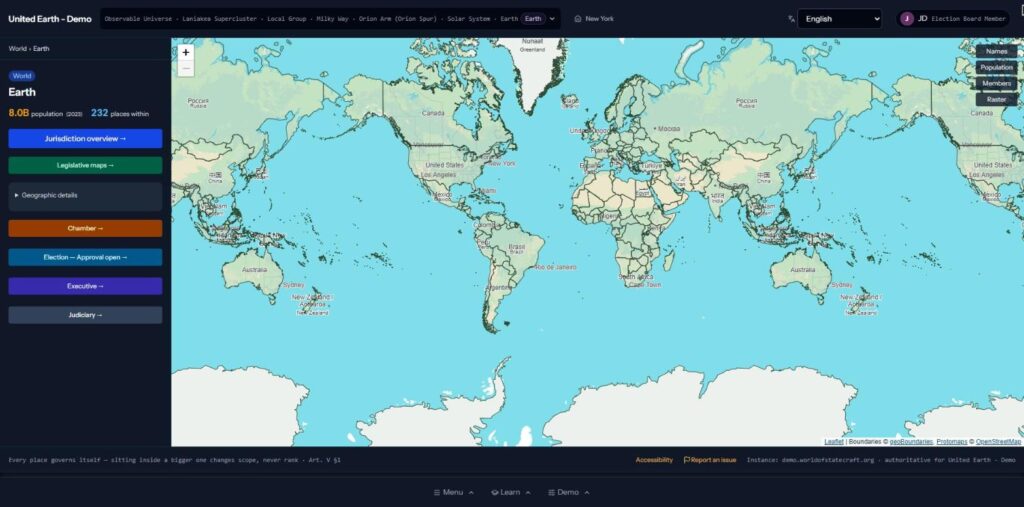
Every Jurisdiction on Earth, Mapped and Seated
World of Statecraft builds nested jurisdictions from open boundary and population data, and lets each one run its own authoritative instance in a federation with no center. The code is open source.
Get Involved
Self-Government at Every Scale
Article V nests co-equal, self-governing jurisdictions from your county to the whole Earth — each with a real voice, none swallowed by another. Help us refine and carry this framework forward.