
Comparing Electoral Systems
Ranked Choice Voting (RCV)
Rank Up to All · One (1) Winner
Voters rank the candidates — 1 for their first choice, 2 for their second, and so on. If a preferred candidate is eliminated, that vote transfers to the next choice still standing.
Test Your Knowledge
This page and its video include a quiz you can take to test your understanding of the content. This lesson is part of a larger education series.
The Setup
How Ranked Choice Voting Works
Walk through a single race. Voters rank the field, and the count runs in rounds — then watch what that produces.
Rank Your Choices
Instead of picking just one, rank the candidates in order of preference. If your top choice is eliminated, your vote moves to your next choice still in the running.
| Rank | Candidate Selection |
|---|---|
| 1st Choice | |
| 2nd Choice | |
| 3rd Choice | |
| 4th Choice | |
| 5th Choice | |
| 6th Choice | |
The Candidates & Their Votes
First-choice tallies rarely settle it outright. The count runs in rounds, transferring votes from eliminated candidates until someone reaches a majority — here D (Yellow).
| Candidate | Faction | Votes | Share |
|---|---|---|---|
| D | 🟨 Yellow | 200,000 | (50%) |
| - F | - 🟩 Green | 110,000 | 11% |
| - J | - 🟪 Purple | 10,000 | 1% |
| - B | - 🟧 Orange | 160,000 | 16% |
| - A | - 🟥 Red | 20,000 | 2% |
| G | 🟦 Blue | 300,000 | (39%) |
| - J | - 🟪 Purple | 30,000 | 3% |
| - B | - 🟧 Orange | 50,000 | 5% |
| - A | - 🟥 Red | 10,000 | 1% |
| - | Dropped | 110,000 | 11% |
What the Vote Produces
Follow one race from the ranked ballots to who ends up ruling. Each step uses the real numbers from the ballot above.
Vote Share
Once ballots are ranked, the lowest-placed candidate is eliminated first and their second-choice votes are redistributed.
Outcome
RCV gives voters real alternatives — yet, as shown, large shares of the electorate can still be locked out of government at any one time.
Seat Control
Here D (Yellow) wins only thanks to transferred support from F (Green), J (Purple), B (Orange) and A (Red).
Committee Control
Even with a broad coalition behind the winner, one faction still takes the single seat — and with it, the committee.
The Count
How the Rounds Are Counted
No majority on the first count? Eliminate the lowest, transfer their ballots to the next choice, and repeat — round by round until someone crosses 50%.
After voters rank their candidates, the candidate with the least votes is eliminated first and their voters 2nd choice votes are redistributed. This process repeats until One (1) Candidate reaches a majority or there is only one candidate standing. Unlike two-round voting (not depicted), voters are able to rank their choices in a single ballot rather than having to return to the polls to vote in a second ballot. In this example, voters from other factions coalesced around D🟨(Yellow) to achieve victory of major rivals G🟦(Blue) and B🟧(Orange).
Follow the Votes — Round by Round
Step through each round and watch the ballots flow. Each band is colored by the party the votes came from; when a candidate is eliminated (greyed out) their ballots transfer to the next choice, until someone crosses the 50% majority and wins the single seat — marked with a gold medal.
The Catch
RCV Still Tends Toward Two Parties
Ranked choice removes the spoiler effect — but strategic voting and district-drawing still push toward two dominant camps.
Two Party Deadlock
Like in FPTP, under RCV Factions are forced to strategically vote to gain a competitive edge. However, unlike FPTP, the Spoiler Effect is not present.
| Faction | Count | Vote Share |
|---|---|---|
| 🟧 Orange | 510,000 | 49% |
| 🟦 Blue | 490,000 | 51% |
Strategic District Drawing
Because RCV also tends toward two parties, Power structures under RCV can draw electoral maps so that future election results are likely to favor the status quo.
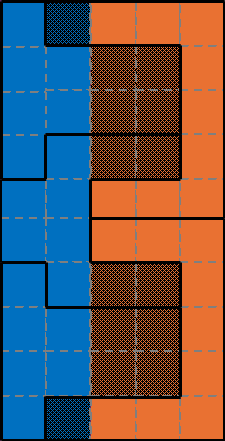
| Faction | Count | Vote Share |
|---|---|---|
| 🟧 Orange | 600,000 | 60% |
| 🟦 Blue | 400,000 | 40% |
| 🟧 Orange | 🟦 Blue |
|---|---|
| 2 | 3 |
A More Representative Way
Proportional Ranked Choice Voting
RCV fixes the spoiler effect, but one seat still means one winner — and RCV still drifts toward two parties. PR-RCV keeps the ranked ballot and elects several winners, so seats match how people actually voted.
Head to Head
The Four Systems, Compared
The same electorate, four systems. Step through each — its real ballot, its real charts, and the share of voters it actually represents.
Autocratic Voting
The prevailing power structure controls who may run and who may vote. Every candidate who threatens the incumbent is disqualified before the vote.
Vote Share
Outcome
Seat Control
Your Ballot
| Leader Appointment |
|---|
The Result
12%
Voters Represented
The verdict: the vote is a formality — after disqualification, one faction controls every seat and the governed have no real say.
Plurality Voting (FPTP)
One vote each, one winner per race — whoever finishes first, even without a majority.
Vote Share
Outcome
Seat Control
Your Ballot
| Candidate Selection |
|---|
The Result
30%
Voters Represented
The verdict: the largest faction takes the seat outright. Everyone who backed anyone else — most voters — wins nothing.
Ranked Choice Voting (RCV)
Voters rank the candidates; the lowest is eliminated and ballots transfer to the next choice until someone holds a majority.
Vote Share
Outcome
Seat Control
Your Ballot
| Rank | Candidate Selection |
|---|---|
| 1st Choice | |
| 2nd Choice | |
| 3rd Choice | |
| 4th Choice | |
| 5th Choice | |
| 6th Choice | |
The Result
50%
Voters Represented
The verdict: the winner now has majority support and the spoiler effect is gone — but one seat still means one faction controls it.
Proportional Ranked Choice Voting (PR-RCV)
Voters rank candidates for a multi-seat race. A candidate needs only a proportional quota — here 20%, for five seats.
Vote Share
Outcome
Seat Control
Your Ballot
| Rank | Candidate Selection |
|---|---|
| 1st Choice | |
| 2nd Choice | |
| 3rd Choice | |
| 4th Choice | |
| 5th Choice | |
| 6th Choice | |
| 7th Choice | |
| 8th Choice | |
| 9th Choice | |
| 10th Choice | |
The Result
95%
Voters Represented
The verdict: several factions win seats from the same race, so control is shared in proportion to the vote — almost everyone is represented.
Want the full mechanics behind every system?
The Better Model
Proportional RCV in Action
Keep the ranked ballot, but elect several winners from one race. Here is that same electorate under proportional ranked choice voting.
PR-RCV keeps the ranked ballot you just used, but each race fills several seats at once — more winners per district, or several districts combined into one. Here five seats are filled at a 20% quota.
The Multi-Winner Ballot
| Candidate | Faction | Count | Share |
|---|---|---|---|
| B | 🟧 Orange | 170,000 | (20%) |
| A | - 🟥 Red | 30,000 | 3% |
| D | 🟨 Yellow | 110,000 | (20%) |
| E | - 🟨 Yellow | 90,000 | 9% |
| F | 🟩 Green | 120,000 | (20%) |
| C | - 🟧 Orange | 70,000 | 7% |
| A | - 🟥 Red | 10,000 | 1% |
| G | 🟦 Blue | 200,000 | (20%) |
| J | 🟪 Purple | 80,000 | (15%) |
| I | - 🟦 Blue | 20,000 | 2% |
| G | - 🟦 Blue | 40,000 | 4% |
| H | - 🟦 Blue | 10,000 | 1% |
| · | Dropped | 50,000 | 5% |
How to Read It
The result: five different factions each clear the quota — a spread of parties in proportion to the vote, instead of one winner-take-all seat.
PR-RCV Outcome
PR-RCV Seat Control
Why It Wins
Why Proportional RCV Wins
Only proportional ranked choice keeps the final outcome matching the voters' interests. Here is what that unlocks.
Protects Diversity
Because seats are awarded in proportion to the vote, every political group holds a share of power at all times — not just whoever narrowly won the last election. Minority voices stay represented instead of being erased between cycles.
Breaks Deadlocks
Two-party systems built on First Past the Post tend to lock into gridlock, each side able to block the other. Proportional representation opens the floor to more parties, so shifting coalitions can form and actually move legislation forward.
Enhances Efficiency
In one-party and no-party states, autocratic incentives reward loyalty over results and let problems fester. PR-RCV replaces those incentives with genuine competition, pushing officials to govern effectively to keep their support.
Empowers Party Members
Members no longer have to fall in line behind a single leader to matter. Because several candidates from one party can win, individual members carry real weight and can champion the issues their own communities care about.
Increases Leverage for Legislators
Individual legislators gain the leverage to represent their own jurisdictions rather than simply voting as faction leadership dictates. That independence gives local communities a far stronger voice in national negotiations.
Ensures Neutrality
When no single faction can dominate, the pressure on speakers, chairs, civil officers, and other appointees to take sides falls away. Balanced power lets them stay genuinely neutral and carry out their duties impartially.
Promotes Cooperation
Because a single faction rarely wins an outright majority, governing requires building coalitions and finding common ground. That structural nudge rewards cooperation and negotiation over the winner-take-all combativeness of other systems.
From One Winner to Many
World of Statecraft uses the multi-seat form of ranked voting, so that nearly every voter helps elect someone. See the full election cycle. The code is open source.

Get Involved
Help Us Complete This Vision!
Ranked choice is a real step up — but one seat still means one winner. Bring your creativity, skills, or resources to the Cosmopolitan Coalition and help build a system where seats match the voters.