
Comparing Electoral Systems
Plurality Voting (FPTP)
Pick One (1) · One (1) Winner
Plurality voting — also called First-Past-the-Post — is a method where the option with the most votes wins, even without a majority.
Test Your Knowledge
This page and its video include a quiz you can take to test your understanding of the content. This lesson is part of a larger education series.
The Setup
How Plurality Voting Works
Walk through a single race. Every voter picks one candidate, the front-runner takes the seat — then watch what that simple rule produces.
Cast Your Vote
Each voter picks exactly one candidate, and whoever gets the most votes wins the seat — a majority is never required.
| Candidate Selection |
|---|
The Candidates & Their Votes
In this example G (Blue) wins with just 30% — over 70% of voters preferred someone else, yet their votes elect no one.
| Candidate | Faction | Count | Vote Share |
|---|---|---|---|
| A | 🟥 Red | 50,000 | 5% |
| B | 🟧 Orange | 250,000 | 25% |
| D | 🟨 Yellow | 200,000 | 20% |
| F | 🟩 Green | 120,000 | 12% |
| G | 🟦 Blue | 300,000 | 30% |
| J | 🟪 Purple | 80,000 | 8% |
What the Vote Produces
Follow one race from the votes cast to who ends up ruling. Each step uses the real numbers from the ballot above.
Vote Share
A majority — over 50% — is never required to win in this system.
Outcome
No matter how many options run, the choice with the most votes beats all others — even with only minority support.
Seat Control
Here G (Blue) takes the seat over more than 70% of voters, on just 30% support.
Committee Control
Winning that single seat with a minority of the vote, one faction still takes full control of the committee.
The Cost
How Plurality Decays Over Time
A minority winner is only the start. Repeat the same rule across elections and it pushes everyone into two permanent camps.
Problems at Scale Over Time
Voters compromise their own interests and coalesce permanently under a single identity and banner after each election until two permanent camps emerge and swap power between themselves over time.
1st Election Cycle
Blue🟦 wins with 30% of the vote, capitalizing on the divided opposition. In response, 🟨 Yellow decides to merge with Orange🟧 for the next election, aiming to strengthen their combined position.
| Faction | Count | Vote Share |
|---|---|---|
| 🟥 Red | 50,000 | 5% |
| 🟧 Orange | 250,000 | 25% |
| 🟨 Yellow | 200,000 | 20% |
| 🟩 Green | 120,000 | 12% |
| 🟦 Blue | 300,000 | 30% |
| 🟪 Purple | 80,000 | 8% |
2nd Election Cycle
In the second election, Orange🟧 wins with 45% of the vote, thanks to the support from 🟨 Yellow. In response, Blue🟦 and Purple🟪 consolidate with Green🟩for the next cycle, aiming to build a stronger coalition.
| Faction | Count | Vote Share |
|---|---|---|
| 🟥 Red | 50,000 | 5% |
| 🟧 Orange | 450,000 | 45% |
| 🟩 Green | 120,000 | 12% |
| 🟦 Blue | 300,000 | 30% |
| 🟪 Purple | 80,000 | 8% |
3rd Election Cycle
Orange🟧 loses with 45%, as Blue🟦 wins with 50%, leveraging the vote split caused by Red🟥. Following this, Red🟥 consolidates under Orange🟧, resulting in a two-party system in subsequent cycles.
| Faction | Count | Vote Share |
|---|---|---|
| 🟥 Red | 50,000 | 5% |
| 🟧 Orange | 450,000 | 45% |
| 🟦 Blue | 500,000 | 50% |
Two-Party Deadlock
In subsequent Election Cycles, two parties consolidate power and are incentivized to keep it for themselves. Power balances on a razor's edge in an escalating arms race of opposing ideologies.
Fourth Election Cycle
| Faction | Count | Vote Share |
|---|---|---|
| 🟧 Orange | 510,000 | 49% |
| 🟦 Blue | 490,000 | 51% |
Fifth Election Cycle
| Faction | Count | Vote Share |
|---|---|---|
| 🟧 Orange | 490,000 | 49% |
| 🟦 Blue | 510,000 | 51% |
The Trap
The Spoiler Effect
When a third choice enters, it splits the vote and hands victory to the side its own supporters least wanted.
Alternate Voices Locked Out
Plurality voting makes it impossible for alternate voices to be heard by making less established factions unelectable.
| Faction | Count | Vote Share |
|---|---|---|
| 🟧 Orange | 500,000 | 50% |
| 🟦 Blue | 450,000 | 45% |
| 🟪 Purple | 50,000 | 5% |
Splitting the Vote Backfires
Every time a small party gains traction, the vote breaks in favor of the ideological opposite of the smaller party.
| Faction | Count | Vote Share |
|---|---|---|
| 🟧 Orange | 470,000 | 47% |
| 🟨 Yellow | 30,000 | 3% |
| 🟩 Green | 20,000 | 2% |
| 🟦 Blue | 480,000 | 48% |
Honest Voting Punished
Under Plurality Voting, voting for one’s actual interests is disincentivized.
| Faction | Count | Vote Share |
|---|---|---|
| 🟥 Red | 50,000 | 5% |
| 🟧 Orange | 450,000 | 45% |
| 🟦 Blue | 500,000 | 50% |
The Slide
From Plurality to Autocracy
Left unchecked, winner-take-all rewards drawing the maps and raising the barriers to voting — democracy in form, autocracy in effect.
Over time democratic rule decays into autocratic rule and it’s accompanying consequences.
Strategic District Drawing
Power structures draw electoral maps so that future election results are likely to favor the status quo. This leads to autocratic election outcomes in most areas, resulting in government structures being unaccountable to the governed.
Strategic Configuration 1
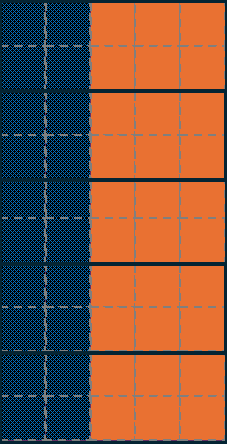
In this configuration, the districts are drawn in such a way that Orange🟧, despite having 60% of the vote, wins all 5 districts, effectively locking out Blue🟦 from representation entirely.
| 🟧 Orange | 🟦 Blue |
|---|---|
| 5 | 0 |
Strategic Configuration 2
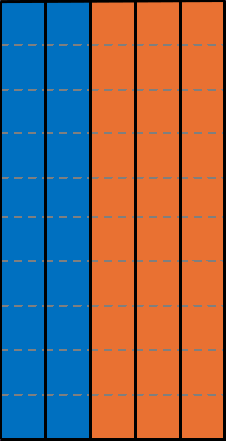
This configuration creates a slightly more balanced distribution, where Orange🟧 wins 3 districts and Blue🟦 wins 2. Here, the district lines are drawn to ensure that Orange🟧 retains a majority but allows some representation for Blue🟦.
| 🟧 Orange | 🟦 Blue |
|---|---|
| 3 | 2 |
Strategic Configuration 3
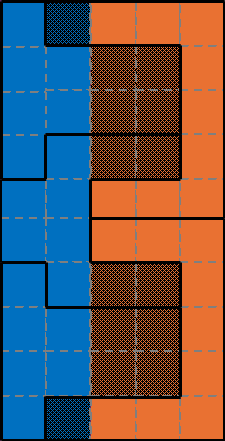
In this configuration, the districts are manipulated to favor Blue🟦 with 3 districts, while Orange🟧 wins only 2, despite Orange🟧 having a majority of the overall vote (60%). This is achieved by spreading Orange🟧 voters thinly across more districts while concentrating Blue🟦 voters in just enough districts to secure a win.
| 🟧 Orange | 🟦 Blue |
|---|---|
| 2 | 3 |
Suppressing the Vote
Where districts cannot be drawn to guarantee the outcome, the same power structures raise the cost of voting itself.
Defund Election Infrastructure
For the districts that are not predictable, or are predictably against the status quo, voting infrastructure can be removed, and barriers to voting and standing for office are put in place.
Target Rival Interests for Disenfranchisement
Target behaviors or attributes commonly associated with members of rival political blocks. Make it illegal and use it as a pretense to remove the right to vote.
Poll Taxes and Hidden Fees
Exploit Financial hardships in the most likely to be upset with the status quo to keep as many from voting as possible.
Non-Automatic Registration
Disenfranchisement via technical paperwork that need not exist in the first place.
Unsubsidized Identification Requirements
When combined with Registration Fees and Travel requirements, acquiring identification documents is a financial and time burden that applies disproportionately against those not benefiting in the status quo.
A More Representative Way
Proportional Ranked Choice Voting
No other system comes close to having the final outcome match the voters’ interests. Instead of handing the seat to a 30% plurality, PR-RCV shares seats in proportion to how people actually voted.
Head to Head
The Four Systems, Compared
The same electorate, four systems. Step through each — its real ballot, its real charts, and the share of voters it actually represents.
Autocratic Voting
The prevailing power structure controls who may run and who may vote. Every candidate who threatens the incumbent is disqualified before the vote.
Vote Share
Outcome
Seat Control
Your Ballot
| Leader Appointment |
|---|
The Result
12%
Voters Represented
The verdict: the vote is a formality — after disqualification, one faction controls every seat and the governed have no real say.
Plurality Voting (FPTP)
One vote each, one winner per race — whoever finishes first, even without a majority.
Vote Share
Outcome
Seat Control
Your Ballot
| Candidate Selection |
|---|
The Result
30%
Voters Represented
The verdict: the largest faction takes the seat outright. Everyone who backed anyone else — most voters — wins nothing.
Ranked Choice Voting (RCV)
Voters rank the candidates; the lowest is eliminated and ballots transfer to the next choice until someone holds a majority.
Vote Share
Outcome
Seat Control
Your Ballot
| Rank | Candidate Selection |
|---|---|
| 1st Choice | |
| 2nd Choice | |
| 3rd Choice | |
| 4th Choice | |
| 5th Choice | |
| 6th Choice | |
The Result
50%
Voters Represented
The verdict: the winner now has majority support and the spoiler effect is gone — but one seat still means one faction controls it.
Proportional Ranked Choice Voting (PR-RCV)
Voters rank candidates for a multi-seat race. A candidate needs only a proportional quota — here 20%, for five seats.
Vote Share
Outcome
Seat Control
Your Ballot
| Rank | Candidate Selection |
|---|---|
| 1st Choice | |
| 2nd Choice | |
| 3rd Choice | |
| 4th Choice | |
| 5th Choice | |
| 6th Choice | |
| 7th Choice | |
| 8th Choice | |
| 9th Choice | |
| 10th Choice | |
The Result
95%
Voters Represented
The verdict: several factions win seats from the same race, so control is shared in proportion to the vote — almost everyone is represented.
Want the full mechanics behind every system?
The Better Model
Proportional RCV in Action
Ranked, multi-winner elections let several factions win seats from a single race. Here is that same electorate under proportional ranked choice voting.
PR-RCV works like RCV, but each race fills several seats at once — more winners per district, or several districts combined into one. Here five seats are filled at a 20% quota, so a candidate needs only a fifth of the vote to win.
The Multi-Winner Ballot
| Candidate | Faction | Count | Share |
|---|---|---|---|
| B | 🟧 Orange | 170,000 | (20%) |
| A | - 🟥 Red | 30,000 | 3% |
| D | 🟨 Yellow | 110,000 | (20%) |
| E | - 🟨 Yellow | 90,000 | 9% |
| F | 🟩 Green | 120,000 | (20%) |
| C | - 🟧 Orange | 70,000 | 7% |
| A | - 🟥 Red | 10,000 | 1% |
| G | 🟦 Blue | 200,000 | (20%) |
| J | 🟪 Purple | 80,000 | (15%) |
| I | - 🟦 Blue | 20,000 | 2% |
| G | - 🟦 Blue | 40,000 | 4% |
| H | - 🟦 Blue | 10,000 | 1% |
| · | Dropped | 50,000 | 5% |
How to Read It
The result: five different factions each clear the quota — a spread of parties in proportion to the vote, instead of one winner-take-all seat.
PR-RCV Outcome
PR-RCV Seat Control
Why It Wins
Why Proportional RCV Wins
Only proportional ranked choice keeps the final outcome matching the voters' interests. Here is what that unlocks.
Protects Diversity
Because seats are awarded in proportion to the vote, every political group holds a share of power at all times — not just whoever narrowly won the last election. Minority voices stay represented instead of being erased between cycles.
Breaks Deadlocks
Two-party systems built on First Past the Post tend to lock into gridlock, each side able to block the other. Proportional representation opens the floor to more parties, so shifting coalitions can form and actually move legislation forward.
Enhances Efficiency
In one-party and no-party states, autocratic incentives reward loyalty over results and let problems fester. PR-RCV replaces those incentives with genuine competition, pushing officials to govern effectively to keep their support.
Empowers Party Members
Members no longer have to fall in line behind a single leader to matter. Because several candidates from one party can win, individual members carry real weight and can champion the issues their own communities care about.
Increases Leverage for Legislators
Individual legislators gain the leverage to represent their own jurisdictions rather than simply voting as faction leadership dictates. That independence gives local communities a far stronger voice in national negotiations.
Ensures Neutrality
When no single faction can dominate, the pressure on speakers, chairs, civil officers, and other appointees to take sides falls away. Balanced power lets them stay genuinely neutral and carry out their duties impartially.
Promotes Cooperation
Because a single faction rarely wins an outright majority, governing requires building coalitions and finding common ground. That structural nudge rewards cooperation and negotiation over the winner-take-all combativeness of other systems.
An Election Without Spoilers or Gatekeepers
World of Statecraft fills every seat with a proportional ranked count, after an open approval phase that any resident can enter. The code is open source.

Get Involved
Help Us Complete This Vision!
First-Past-the-Post rewards the front-runner and wastes everyone else’s vote. Bring your creativity, skills, or resources to the Cosmopolitan Coalition and help build a system where every vote counts.