
World of Statecraft · Self-Hosting
Run a Node
Host your own instance on your own hardware, keep full custody of your own records, and join a federation that has no center. One command, from a Raspberry Pi to a cloud server.
Watch the Walkthrough
From an Empty Machine to a Live World
A film of a complete installation, from the first command to a seated world, is in production.
Whoever Holds the Server Holds the Record
Municipalities are laboratories for democratic innovation, and a laboratory should own its own instruments. A council that hosts its own instance holds its own records, sets its own pace, and owes nothing to a supplier. There is no licence fee and no vendor. The code is open source under the Apache 2.0 licence, and the constitutional rules it carries are in the public domain.
The same is true for a community that has no institution to rely on: a diaspora, a community in exile, a neighborhood after a disaster, or a youth council with a spare laptop. The engine was written so that the smallest machine can run the whole system. A slower computer takes longer. It does not get a lesser version.
From a Raspberry Pi to a Cloud Server
Every heavy task is cut into small, resumable pieces that size themselves to the machine. The same code runs on a single-board computer and on a large server. An interruption costs one piece of work, not the whole job.
Full Custody of Your Data
The jurisdiction owns its instance and its data. Updates arrive by running the same start command again, and they never touch your settings or your records.
Communication Built In
Each instance hosts its own chat and voice services, so the public square and the meeting rooms depend on no outside platform and have no central owner.
Ready for Serious Hosting
A high-availability configuration with database failover is included for a host that needs it, along with a guide for putting a node on the public internet at your own domain.
Six Steps From an Empty Machine to a Live World
The setup wizard asks its questions in a browser and carries the founder the rest of the way. The constitutional defaults are presented as a starting reference, not as locks, and the founder may change them within the limits the constitution itself allows. The map data step can scope the import to a single country for a fast first world, or download the datasets country by country from inside the app.
Many Instances, One World, No Center
Join as a Mirror in One Step
Any computer can join an existing world as a mirror. It receives the public record and keeps it in step. A mirror is authoritative for nothing, so adding one can only add resilience.
Full Faith and Credit
Public records carry across instances. A city, a region, and a country can each run their own authoritative instance and still form one nested system, which is how multi-level government works in practice.
Nothing Private Federates
Federation carries a signed copy of the public audit record and public records only. It never carries ballots, raw locations, or credentials.
Restoration When a Government Fails
If a government is captured or destroyed, the constitution provides an ordered path to restore it: first its member jurisdictions, then the jurisdiction above it, then the residents themselves. Because the record is mirrored, there is something left to restore from.
The Survival Mesh
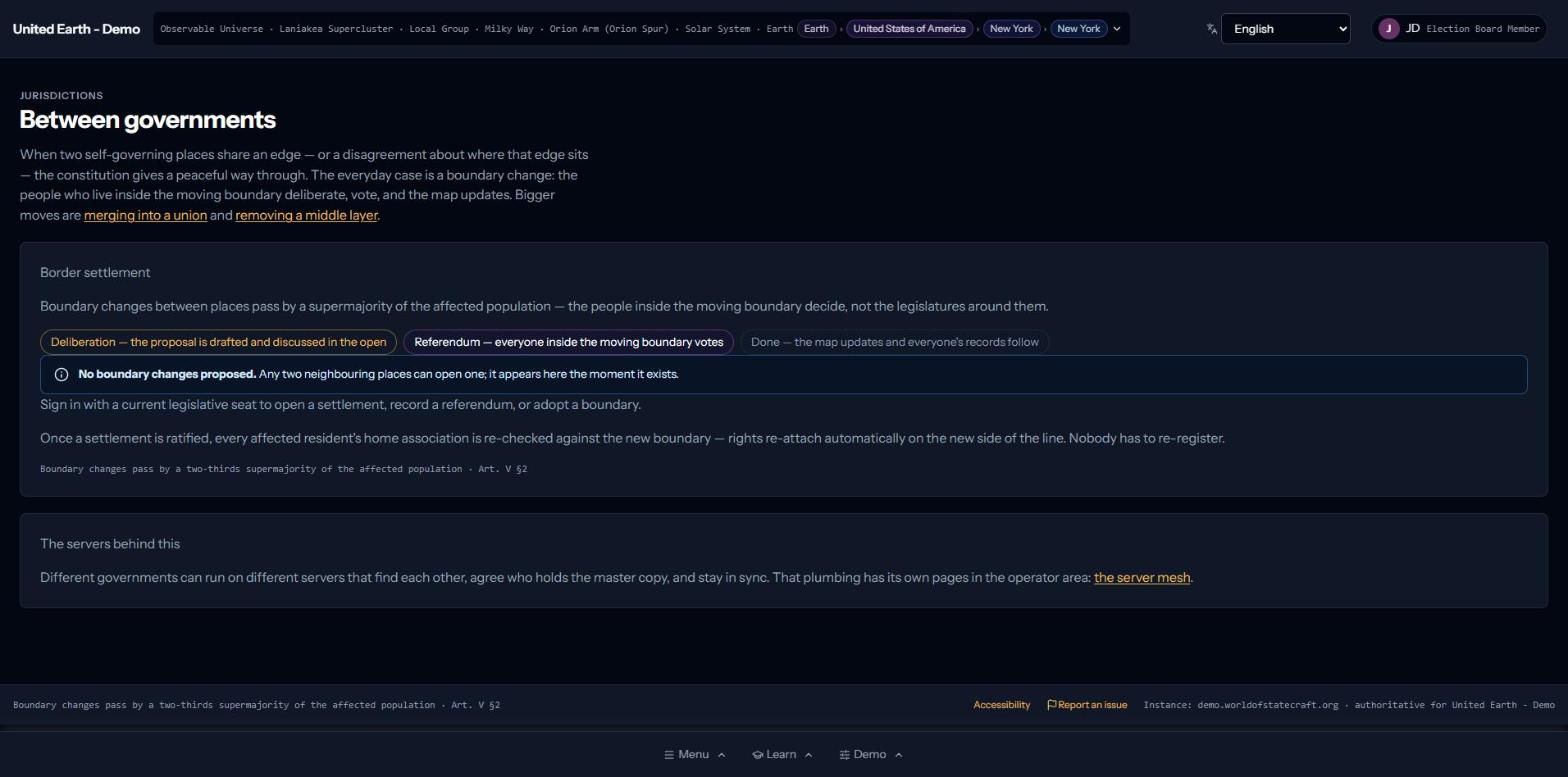
Between governments, in the live demo.
Between Governments
When two self-governing places share an edge, or disagree about where it sits, the constitution gives a peaceful way through. The people who live inside the moving boundary deliberate and vote, the change passes by a two-thirds supermajority of the affected population, and the map updates. Rights re-attach automatically on the new side of the line, and nobody has to register again.
Jurisdictions can also merge into a union or remove a middle layer, each as a defined constitutional process with its own thresholds.
Operators Keep the Box On. They Hold No Office.
The operator area is where a host manages peers, transports, and the sync ledger. It is walled off from the civic game. A signed-in operator sees it, and an ordinary resident does not.
The page says so itself. Joining, syncing, and naming peers are capabilities. They buy no vote, no seat, and no say in any constitutional act.
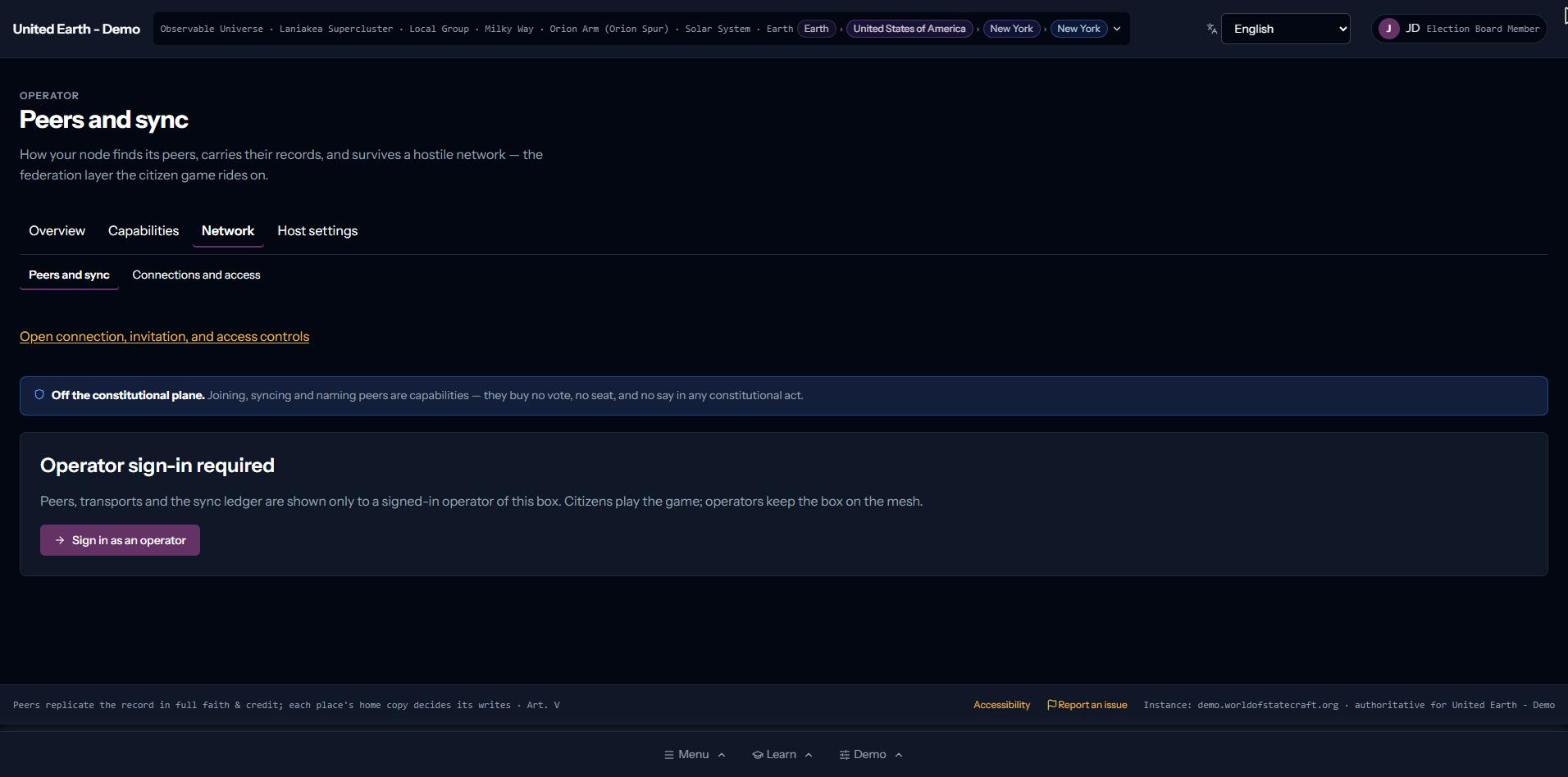
The operator area in the live demo, seen by a resident who is not an operator.
Running the server gives a person control of the machine, not of the constitution. The rules of the polity change only through valid legislative acts recorded on the public chain. The settings an operator can reach govern the box: addresses, certificates, and capacity. The software is pre-alpha and has not been security-audited, so a node today is for evaluation and pilots, not for binding decisions.
Open the Live Demo and the Documentation
Federation
Peers, sync state, and the authoritative instance for each place.
The Simulation Console
How a demonstration world is populated, step by step.
The Install Guide
One command for Windows, macOS, Linux, or a Raspberry Pi.
Running on the Internet
How to put a node at your own domain with working chat and voice.
Operator Runbooks
Every infrastructure setting, and how to change it safely.
Related Reading
The Constitutional Engine
One gate for every civic act, a tamper-evident public record, and rules no administrator can bend.
How the Maps Are Drawn
Open boundary and population data, combined into first-draft districts for the whole planet.
Jurisdictions in the Template
Nested jurisdictions, unions, and the powers they share.
Constitutional Order in the Template
How a constitutional order is protected and restored.
Get Involved
Host a Pilot. Break It. Tell Us How.
A pilot instance in a real municipality, university, or civil society network is the most valuable thing this project can receive. We are also looking for an independent security audit and for people who run infrastructure in difficult conditions.