World of Statecraft · Transparency

The Atlas

The whole world on one public screen: representation, justice, organizations, the economy, and the network that carries it. Built as a gauge and never a lever.

COMING SOONThis walkthrough is being recorded. If you can script, narrate, animate, or edit, help us produce it.Help Make Our Videos →

Watch the Walkthrough

Reading the Vital Signs of a World

A short film on how to read the Atlas, and what it deliberately refuses to show, is in production.

What It Is

A Live Heartbeat of the Whole System

One read-only page that anyone can open, showing how much of the world is governed, by whom, and how well.

Participation is hard to see. A council can announce that residents were consulted, and nobody outside the room can tell whether ten people took part or ten thousand, or whether the places taking part are the ones that most need a voice. Monitoring usually arrives later, as a survey, a report, or an audit.

The Atlas makes the picture continuous and public. Because every civic act in the engine is already recorded in a standard structure, the state of the world can be summarized every night without asking anyone to fill in a form. The same page works for one town, for a country, and for the planet.

The World

How many jurisdictions exist at each level, how many people they hold, and how many places have come alive with real participants.

Reach

How many verified residents a place has against its estimated population. It measures enrollment, and it is labeled that way. It is not a verdict on anyone's legitimacy.

Representation

Legislatures and seats, filled and open. Elections under way, candidates standing, petitions gathering signatures, committees, and bills.

The Executive

Departments, boards, worker-elected seats, and any emergency powers in force, with the days remaining before they lapse.

The Judiciary

Courts, open cases, constitutional challenges, and juries seated. Juror identities and sealed material are never shown.

Organizations and the Economy

Organizations by type, endorsements made, and workers represented on boards. Public totals for the economy are planned for this page. No wallet balance will ever appear. A wallet is private, like a ballot.

In the Engine

Vital Signs, a Living Map, and a Year of Growth

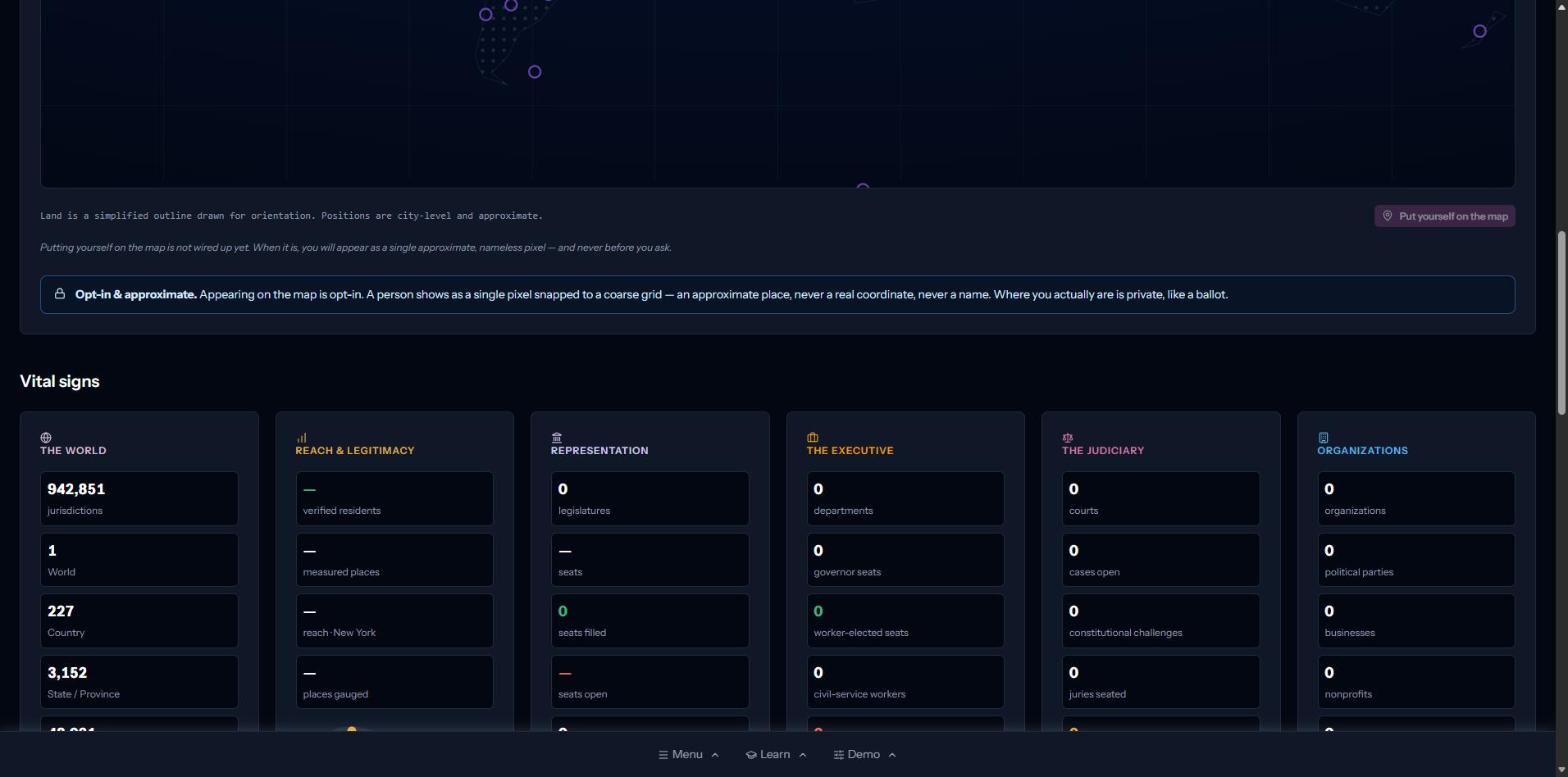
Below the vital signs sit a living map with layers for places, organizations, people who opted in, and the servers that carry the world, then a year of growth, then a list of what needs people right now.

A world that was generated for demonstration is labeled as a simulated world on the page itself, so a demo can never pass for a live society.

The Atlas of a newly founded demo world: 942,851 jurisdictions in 227 countries. The other vital signs fill in as the nightly summary runs.

The Rails

A Gauge, Never a Lever

Measuring participation creates a temptation to act on the measurement. The Atlas is built so that it cannot.

Nothing on the Atlas changes a vote, a seat, or a right, and nothing on it is ever consulted when the engine decides whether someone may vote, stand, or speak. There is no action on the page at all, apart from one planned personal choice: whether to place yourself on the map. A surface that could do something with a headcount would be the first step toward ranking places, and then people, by how well they participate.

1Places, Never People
Only places are measured. There is no score for a person, and no leaderboard of people, anywhere in the system.
2A Privacy Floor of Five
A figure drawn from fewer than five people is withheld, and so are any figures that would let someone work it out by subtraction. A withheld night shows as a gap, never as a zero.
3Snapshots, Never Live Counts
The Atlas reads a nightly summary. A live count would let an observer watch individuals arrive one at a time.
4On the Map Only by Choice
The map is designed to plot a person only if they opt in, and then only as one nameless point snapped to a coarse grid. The default is off, and the opt-in control is not yet wired in the demo.

Digital Tools: Enabler or Intruder?

The honest answer is that the same data can be either. The engine's position is structural. Coordinates used to establish residency never enter the public record. A ballot has no link to a voter anywhere in the database. The Atlas only ever reads figures that have already passed a privacy decision. These are properties of the design, pinned by automated tests, and open to inspection in the source code.

Who Uses It

A Shared Picture for Everyone Who Monitors Participation

Local Governments

See at a glance where seats are empty, where petitions are gathering, and which neighborhoods have not yet found their way in.

Researchers and Observers

Comparable figures across places and over time, produced the same way everywhere, from a record that can be verified.

Civil Society

Find the places that need people right now, and direct outreach where participation is thinnest.

See It Running

Open the Atlas in the Live Demo

The demo is a pre-alpha instance for evaluation. Some areas ask you to sign in, and some open as the demo world finishes building. Nothing entered there is a real civic act.
Keep Exploring

Related Reading

The Constitutional Engine

One gate for every civic act, a tamper-evident public record, and rules no administrator can bend.

How the Maps Are Drawn

Open boundary and population data, combined into first-draft districts for the whole planet.

Run a Node

Host your own instance on your own hardware, and join a federation with no center.

The Legitimacy Tests

The three tests every rule in the engine is measured against.

Individuals in the Template

The rights the privacy rails exist to protect.

Challenges of the Global Community

Why a shared picture of the world matters.

Get Involved

Tell Us What the Gauge Should Never Show

If you work in privacy law, data governance, or human rights monitoring, review the rails and tell us what we missed.